English version is here / 日本語版はこちら
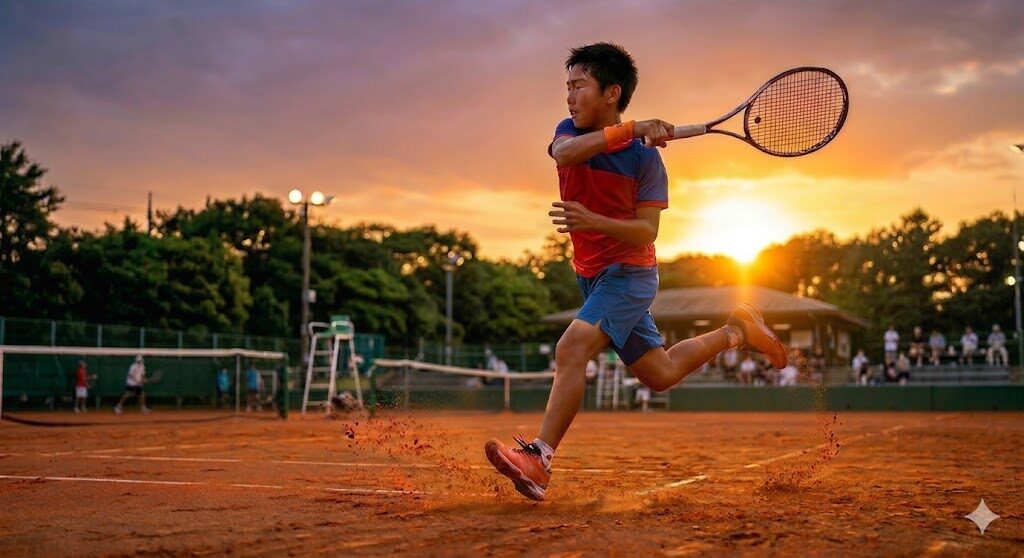
In tennis, the recovery movement after the shot is just as vital as the act of hitting itself. The key to preparing powerfully for the next move is transforming the transition from the finish to the ready position from an unconscious movement into an intentional movement.
Why Unconscious Movement is Ineffective
If recovery remains unconscious, the body will repeatedly be swung around by the momentum of the swing. Since the power transmitted to the racket head is a mixture of various elements, if the pivot point for returning to the neutral position differs unconsciously each time, you will always be a step behind the next shot. Please maintain your axis so that your body is not swung around by centrifugal force.
Pulling Back from the Finish
1. The awareness of Grip-End Lead
When pulling the racket back from the finish, use the grip end as the pivot point. This prevents starting the next move while the center of gravity (axis) is being pulled outward by centrifugal force.
- Benefit 1: Large, wasteful circular motions are eliminated, allowing for recovery via the shortest path
- Benefit 2: The racket head is naturally raised upon completion, making it easier to stabilize the core. (Depending on your type, there is no need to force the head up.) Please lead with the grip end during the recovery phase
2. Imagery of Centrifugal Force
The sensation is similar to the illusion of a bending pencil when shaken. It is the feeling where the tip (head) always follows slightly behind the motion of the hand. Please visualize the racket head lagging behind the grip during the pull-back.
Mobility Sequence for the Pull-Back
The following is the mobility sequence starting from the finish to ensure your biological OS correctly processes the transition.
- Stop at the finish: Please remain stationary for a moment after the finish
- Take the first step: Imagine the next development and step out with one foot while ensuring the core receives the weight of the arms and racket
- Tip: Having the sensation of catching the weight with the muscles attached to the ribs (Rib Cage Catch) allows you to use the front, back, left, and right of your body intentionally
- Pull back the racket: Pull the racket back using the sustaining power of the Pelvis Engine. Please perform this with the intent of organizing your posture rather than rushing
- Maintain the axis: Pull the body upward simultaneously with the next foot movement. For the moving leg, lift the knee and thigh, and use the foot on the ground as an aid for the upward pull
Please perform these steps as slowly as possible to input the correct circuit into the brain.
Strategic Dominance Through Intentional Recovery
It cannot be denied that modern racket performance has made aggressive tennis deceptively easy, which is a major factor in unconscious recovery. While the thrill of winning a point with a single blow is attractive, a shot of escape that neglects recovery will not lead to consistent match results, even if it produces an occasional super shot. In fact, it is a bug that hinders evolution.
The important thing is to complete the recovery via the shortest path even during grueling rallies and to always be prepared to dominate the next phase. Without being captivated solely by the power of a single hit, please clarify the fundamental physical operations, including intentional recovery. This difference in awareness is the process that guarantees total experience and victory.







コメント