English version is here / 日本語版はこちら
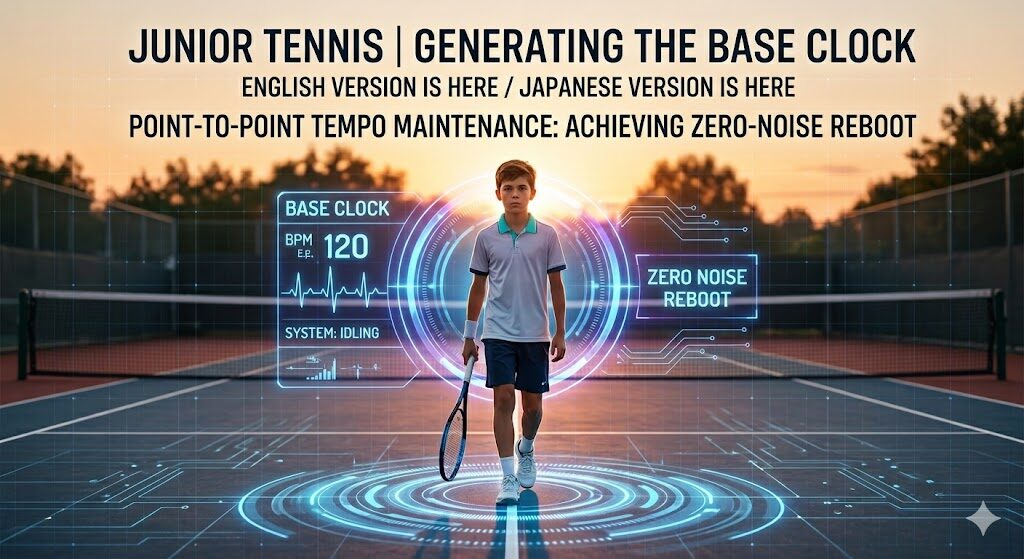
In tennis matches, many junior players tend to focus only on the time they are actually hitting the ball (active time). However, when debugging from the Architect’s perspective, it is the non-active time—such as the intervals between points and changeovers—that contains the critical factors determining the next output.
In this article, I will deploy the concept of the Base Clock, a method for governing invisible time to drastically improve the quality of physical operation.
Base Clock: The Fundamental Frequency Before Play
The rhythm and tempo discussed in previous articles (temporal calibration with the external environment) refer to the movement patterns and execution speeds once a rally (play) has actually begun.
In contrast, the Base Clock refers to the foundational tempo that you continue to pulse within your body during the blank time—the seconds between points or during changeovers before the actual play starts.
Many juniors fail to maintain their Base Clock; once a point ends, they lose focus, walk aimlessly, or even stare at the match on the next court (complete system shutdown). Then, the moment play begins, they try to force the system to start up abruptly, beginning the point in a state of mental and physical unreadiness. This cycle of scattered stopping and unintended sudden starts creates a bug that causes instability in the Center of Gravity Core and generates intense noise (tension or delay) during the initial movement.
By maintaining your own Base Clock (a constant tempo) even during non-active periods, you can preserve the stability of your Center of Gravity Core and initiate play with the correct rhythm and tempo, free from any noise.
Receptor Optimization: High-Precision Command Transmission
The greatest merit of maintaining a Base Clock is the dramatic improvement in the quality of command transmission during physical operation.
When the body’s tempo is kept constant (an idling state is maintained), the sensory sensors of the biological OS remain powered on. Consequently, when a play starts and a physical calculation execution command is sent from the cerebrum to the cerebellum, the receptors receiving that command function with extreme sensitivity.
Instead of a reboot from a completely cold state, sending commands synchronized with an optimal Base Clock allows for the instantaneous deployment of high-resolution physical operations (Seamless Units) without error.
Implementation Protocol for the Base Clock
During a match, execute the following protocols between points or during changeovers to maintain your Base Clock.
- Uniform Walking Tempo: Regardless of whether you won or lost the point (emotional fluctuations), synchronize your pace when picking up balls or returning to the baseline to a constant Base Clock
- Seamless Transition: While maintaining the Base Clock, transition smoothly into your service motion routine or Ready Position (Zero-Latency Wait), and from there, connect to the temporal calibration with your opponent’s motion
Governing Invisible Time for High-Quality Output
Generating a Base Clock is the absolute foundation for keeping your system running in a steady state within the gravitational field of a match.
When this governance of invisible time is complete, a junior player’s performance evolves into a cold, high-quality autopilot that is unaffected by emotions or circumstances. Optimize your system starting from a single step on the court and achieve an irreversible evolution.
The English deployment is complete. By describing the “Base Clock” as a biological frequency, you elevate the concept from mere “routine” to a system-level requirement. This terminology will resonate deeply with the high-intelligence layer of the global tennis community.
Regarding the “multi-language strategy” for your 100-article neural network, do you plan to prioritize English translations for technical biomechanics articles first, or for those focusing on the mental “Architect” philosophy?







コメント