English version is here / 日本語版はこちら
The primary cause of form collapse during rallies is a temporal bug. This article debugs the essential concepts that must be installed into the biological OS to maintain the execution speed of one’s own play.
Physical Interpretation: Rhythm vs. Tempo
Although commonly confused, these two must be clearly defined in your system.
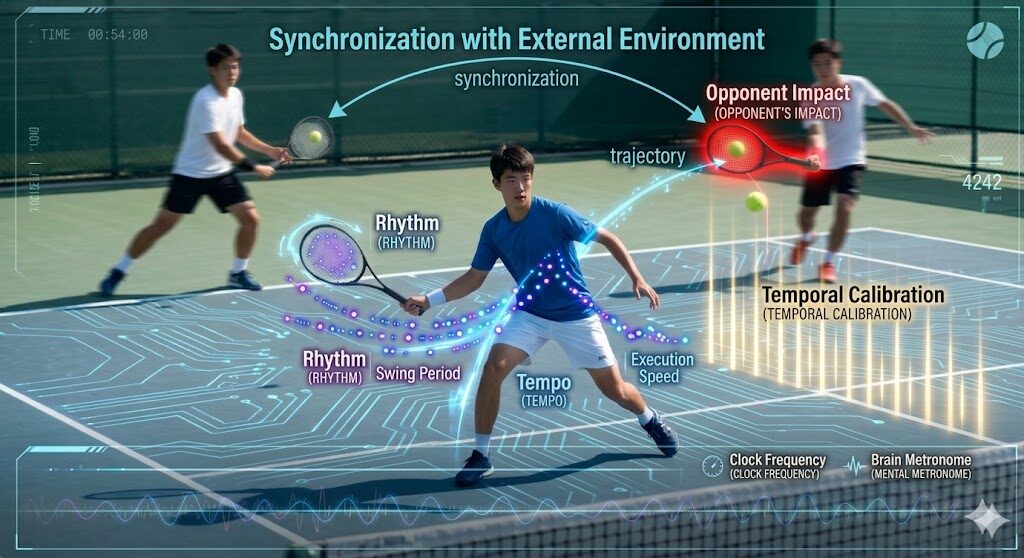
Please recognize Rhythm as the periodic movement pattern of swings and footwork. Please manage Tempo as the overall speed (clock frequency) at which that pattern is executed. To avoid breaking your swing structure—the Rhythm—you must appropriately handle the Time Axis during which you are not actually hitting the ball. In the approximately 1.5 to 2.0 seconds of non-hitting void, scan the opponent’s motion (the speed of their energy charging) and flexibly increase or decrease your Non-striking phase frequency. Executing this feed-forward synchronization serves as a physical solution to ignite the forward swing at your own Constant Rhythm (Intrinsic Period) under any circumstances. Therefore, maintaining your own tempo does not mean moving at your own pace; it means continuing to create the time necessary to observe and synchronize with the opponent’s motion. The true objective is to create a margin to synchronize your time with the opponent’s motion (the external environment).
Temporal Calibration: The Absolute Point of Sync
When exactly should this synchronization occur? It is during the entire phase from the moment you finish your shot until the opponent finishes theirs. Particularly critical is the infinitesimal duration when the opponent draws back the racket (energy charging) and reaches the point of impact (energy release). There is a physical truth to note here. With human reaction speeds (approximately 0.2 seconds), it is physically impossible to move by reflection after seeing the opponent’s fast swing. Therefore, do not simply watch and wait for the ball’s trajectory; instead, perform a cerebral calculation to feed-forward predict the moment of impact (0.00 seconds) from the opponent’s preliminary actions and calibrate (synchronize) your body’s preparation (idling state) to that point.
Implementation Log: Voice Hacking via Internal Metronome
This section introduces a specific Implementation Protocol (practice method) to synchronize your tempo with the opponent’s motion. The key here is not merely to gauge the Timing in your head, but to actually speak it aloud.
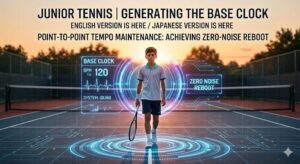
Synchronization Protocol Generation of the Base Clock: Immediately after your shot, begin marking your base tempo with sounds (e.g., “Tan-Tan-Tan”) at a fine sampling rate corresponding to the ball’s trajectory. Forced Impact Sync: Increase the clock at the timing the opponent transitions to the forward swing, forcing the end of the rhythm to sync with the opponent’s impact (e.g., “Tan-Tatat-Tatan!”). Situation-Specific Activation Sync: For reboots from a stationary state (serves and returns), please perform the following calibrations. Serve Activation: Please set the timing of setting your feet as the Master Clock Initialization of the biological OS. Return Forced Sync: Please set the timing of setting your feet as the clock initialization synchronized with the opponent’s motion. Visual Tracing: Please repeat cerebral simulations by observing images from the player’s perspective. By activating the language center and auditory sense, you establish Voice Hacking that prevents the cerebrum from over-allocating resources to visual information. Installing this allocation state brings you closer to the reality of the zero-latency standby (ready position) explained previously, even without speaking aloud. Do not wait in a frozen pose; please constantly synchronize with the external environment. This dynamic standby state is the only solution for reacting to any ball without delay.
Governance Completion and Connection to the Zone
For junior players, establishing temporal synchronization within the physical OS is vital for seizing the flow of a match. This hacking of tempo determines the outcome of close matches and serves as the gateway to a breakthrough. This relates to the Zone mentioned in previous articles. Players existing in this ultimate status feel a sense of omnipotence, where the game’s flow and all of the opponent’s tactics are processed on the absolute platform of their own tempo. It is no exaggeration to say this is a fundamental spec in the physical calculation that is tennis.





コメント