![A high-resolution, cinematic conceptual illustration for "Junior Tennis | Ultimate System Integration." The image features a young Asian male tennis player in a focused mid-swing posture, surrounded by glowing golden mechanical gears and translucent 3D diagrams illustrating the "One-Axial / Two-Axial" physical theory. The background is dark and gritty with a heavy, professional atmosphere. Prominent metallic text at the top reads "[JUNIOR TENNIS] ULTIMATE SYSTEM INTEGRATION" and "The Truth of ‘One-Axial / Two-Axial’ and Power Scaling."](https://potential-tennis.jp/wp-content/uploads/2026/05/Gemini_Generated_Image_17uhfy17uhfy17uh.jpg)
English version is here / 日本語版はこちら
Eliminate the Error Codes.
Conventional tennis concepts such as twisting the body, kicking the ground, or relaxing carry the risk of distancing the player from physical structures and biological systems. These generate muscular friction (X-pattern door swings), unnecessarily exhausting the player. The truth lies in synchronizing physical laws (action-reaction/gravity) with the body’s reflex mechanisms to build a somatic reflex that bypasses conscious brain intervention.
1. Lower Body System: “One-Axial Compression” via Action-Reaction
The role of the lower body is not merely a means of movement, but the origin of energy generation.
- Definition of Origin: Define the origin point approximately 3–5 cm below the knee and connect it evenly to a point approximately 20 cm forward (referred to as A)
- Converge the vector from the inner side of the big toe (around the MP to IP joints) toward A (forming a 2V-Structure)
- This establishes a robust one-axial suspension
- Note that this is not a physical bending of joints, but a directional convergence of intent (vector orientation)
- Source of Energy: Do not rely on voluntary muscular contraction by kicking the ground
- Instead, place the energy source in the accumulation and action-reaction associated with mass transfer from the ready position to stance determination, and finally to the peak of the backswing
- Dynamic Cushion: The upper space created by the 2V-Structure (the inner space between both legs) must function as a dynamic cushion, maintaining footwork flexibility while preventing energy leakage
- Automation of Compression: Ensure that the completion of the backswing automatically achieves downward energy compression
2. Upper Body System: Independent “Two-Axial” and Anchor Functions
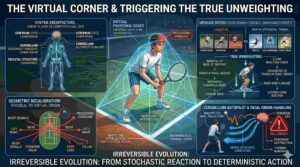
The upper body maintains two I-Axes (conduits) directly connecting the pelvis to the ipsilateral first ribs. Generated energy exhaust must autonomously exit diagonally upward as active dissipation (energy release) without stagnation. Transmission (The Truth of Conversion): Energy generated in the lower body (one-axial) undergoes a phase transition to the upper body’s I-Axes at the conversion points on the pelvis (lines traced from the inner big toes). This synchronization allows for energy delivery with zero friction, structural exclusion of balance disruptions, and prevents collisions at the core.
- Phase Transition to Ground Reaction Force: Downward compressed energy must be immediately converted into ground reaction force per the Law of Action-Reaction
- The physical interface for this is the sole of the foot
- Activation of the Anchor: At the moment the upward thrust (bottom-up) from the lower body strikes the pelvis, the setup form must trigger as a structural anchor
- Forced Conversion of Propulsion: The anchor must forcibly convert linear propulsion into asymmetrical movement (Binary Switching via two I-Axes), completing preparations for an explosive structural restoration without voluntary muscular intervention
- Steady-Cycle Exhaust Mechanism: The exhaust of generated energy must be continuously released through autonomous regulation, maintaining dynamic parallelism with the angle of the 2V-Structure formed by the lower body
- This angular parallelism must eradicate friction (noise) in energy transmission, transitioning the body into a pure conduit
3. Synchronization System: “Automatic Coupling” via Top-Down
Utilize the external mass of the racket to transmit bottom-up energy to the arms.
- Commencement of Gravitational Fall: Initiate the gravitational fall of the racket (top-down) from the peak of the backswing (singularity) toward the racket head down
- Construction of Tension Cables: This fall must expand the chest and pull the arms toward the first ribs, automatically setting up robust tension cables
- Complete Interlock: Realize transmission by synchronizing the action-reaction thrust and the gravitational tension set as an inevitability of physical laws
4. Control System: Unconscious Self-Correction and Buffer
Real-time control by the cerebrum (consciousness) is noise that crashes the system.
- Courage to Monitor: Limit consciousness to the initial setup until stance determination.
- Transition completely to monitoring the forward swing simultaneously with the completion of the racket head down (physical ignition)
- Ultra-High-Speed Error Correction: Allow the cerebellum and spinal cord to automatically execute fine adjustments within the range of motion (dynamic buffer) of muscles and joints, responding to court conditions and ball impact without conscious intervention
5. Survival Strategy: Power Scaling and Rest (Circulation of Static and Dynamic)
To sustain a fully automated system, maintenance protocols are required to prevent wear on biological hardware.
- Power Scaling: Do not perform every shot at maximum output
- Scale down the backswing to the minimum unit of output depending on the situation
- System Cooling (Rest): Return consciousness to default mode during breaks between games or points to resolve system heat-up
- Establishment of Perpetual Operation: Establish the system by ensuring a cycle of high output, minimum unit, and complete rest to prevent overheating
Irreversible Evolution
Physical structure, reflex chains, survival strategies, gravity-driven propulsion, and dynamic convergence of the center of mass core—when these are perfectly integrated, the player is liberated from the obsession with hitting. They undergo a phase transition into a pure conduit through which physical laws pass. This is the irreversible evolution that extracts potential to its absolute limit.






コメント