English version is here / 日本語版はこちら
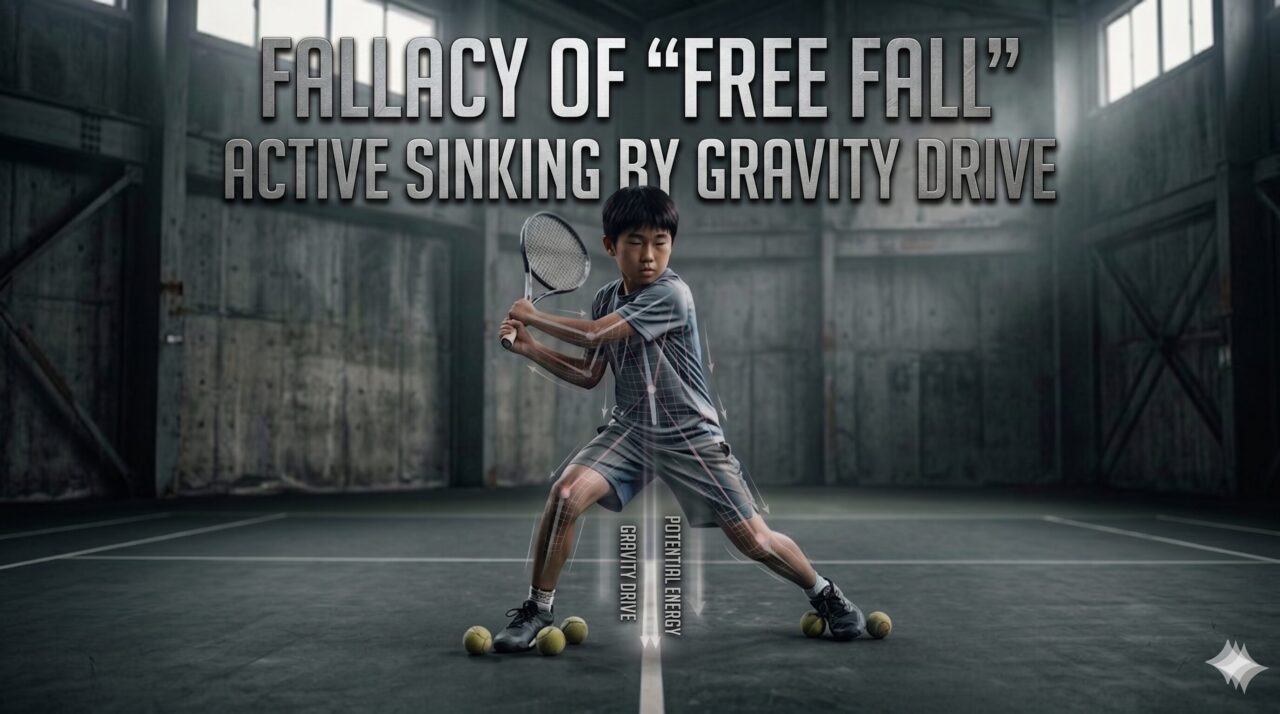
The Trap of Free Fall
In the field of junior development, when lowering the racket, the instruction to relax your power and use the weight of the racket and arm is frequently employed.
At first glance, this sounds logical, but from a physics perspective, the interpretation that Free Fall = Relaxation contains a critical system error.
A perfect free fall is a state where one is simply surrendering to gravity (acceleration $g \approx 9.8\text{ m/s}^2$).
This is identical to a marionette with severed strings, and the moment it receives the intense external reaction of impact, the physical structure collapses, and the energy dissipates in all directions.
What we must aim for is not to just fall, but to hack gravity as a power source to generate propulsion.
Physical Truth: Not Free Fall, but Active Sink
What is required of junior players is not an unprotected free fall.
It is the Active Sink of the center of gravity while maintaining structural tension.
Free fall caused by general relaxation eliminates the structural tension against the base of support along with the locking of the joints.
This is not utilizing gravity; it is merely crashing towards the ground.
In contrast, active sinking refers to the action of dropping the center of gravity using the external force of gravity while maintaining a tensegrity structure where the entire body’s fascial network is taut.
It is vital not to just fall, but to actively pull the center of gravity down using gravity while maintaining tension.
This decisive difference irreversibly evolves the energy efficiency of the swing.
Gravity Drive: Forcible Conversion of Potential Energy into Tension
Why is it necessary to sink while maintaining tension?
It is to convert the potential energy gained from gravity into the kinetic energy of the swing.
Dropping a completely slack rubber band causes nothing, but if an entire taut rubber band is pushed down and then released, a powerful slingshot effect is generated.
What the world calls free fall leads to structural collapse.
The true mechanism advocated by the Architect is the process of converting gravitational acceleration into the pre-stress of the entire structure, that is, Gravity Drive.
Final OS Update: Shifting to Toughness
The reason why the instruction to relax your power hits a dead end is because it lacks the perspectives of structural maintenance and active utilization of gravity.
To hit a truly effortless yet powerful ball, rather than simply relaxing into a free fall, one must utilize gravity to spread tension throughout the entire body and construct a toughness that will not yield to external forces.
In order to improve match results with the hardware of a junior player, rather than resisting gravity with muscular strength, a physical blueprint that forcibly converts gravity into one’s own energy is indispensable.







コメント