English version is here / 日本語版はこちら
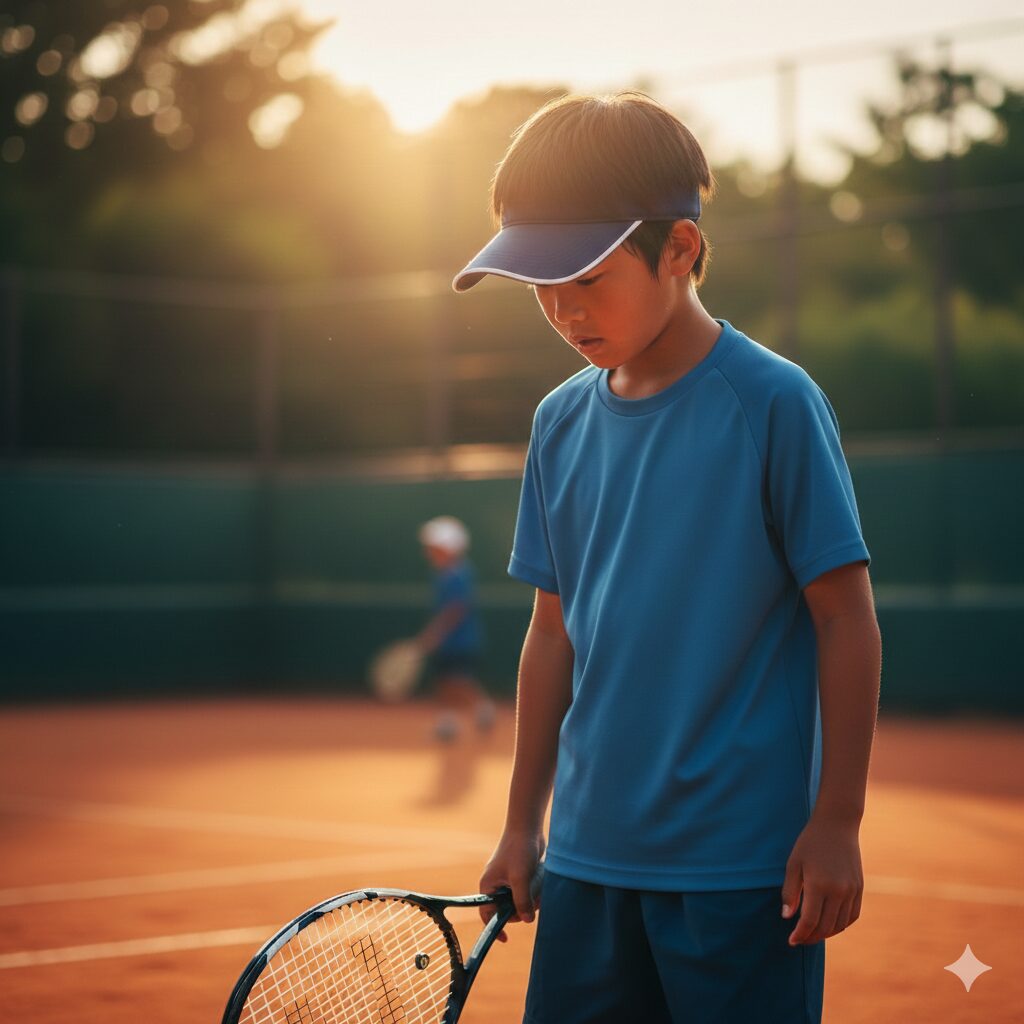
In the harsh competitive environment of junior tennis, there is a common wall you encounter during a specific stage. It is the period when players break out of a slump and finally start to produce tournament results. In practice, they hit sharp balls that can surprise even higher-ranked players. However, in an actual match, that dynamism vanishes, and their swing shrinks.
Why won’t they play like they do in practice? Parents watching from the sidelines feel this frustration deeply. I myself, as a former junior player, experienced the phenomenon where the body stiffens and fails to move as intended—Winning Jitters—right in the middle of the court. The true nature of these jitters is the ambiguity of focus between mentality and technique. It is an inevitable trap: falling into passive play precisely because you can feel that victory is within reach.
Winning Jitters Occur Because Focus is Solely on the Result
Since it is a competition, it is natural to care about the outcome. Playing without caring at all is impossible. Even junior players must stand on the court and perform while coming to terms with that desire. The more you play feeling that you can win, the more the brain executes a Rejection of Risks.
This error code clearly appears in internal thoughts such as: If I make this shot, I will gain the momentum, or If I win this point, it leads to victory. Conversely, it is the cycle of Desire to Win leading to the Fear of Losing. Through Video Analysis, it is clear that footwork becomes dull and the scale of the swing shrinks in matches compared to practice. It is a physical Freeze that occurs the moment the brain executes a Rejection of Mistakes. To overcome this freeze and translate efforts into tournament results, a specific protocol must be installed.
Overcoming the Freeze to Secure Tournament Results
First, have the player confirm the difference between a shot made without pressure and a shot missed under pressure. Utilize Video Review as a powerful tool for sharing insights between parents and coaches. Check the details thoroughly—whether the footwork has dulled, the swing has shrunk, or the body’s vector has shifted.
Next, determine what to be conscious of in those high-pressure situations. Shots that are effortless without pressure become impossible during a freeze. Therefore, decide in advance what to focus on during those moments.
Chance Ball Protocol: Execute a pre-set movement without hesitation Crucial Point Focus: Concentrate entirely on a single technical focal point Instruction Simplicity: Keep these instructions simple to avoid cognitive overload
Even movements mastered in practice are forgotten by the body during a freeze. However, this network malfunction begins to recover once a single circuit is restored. Rather than scattering attention, focus entirely on one single thing to break the freeze and produce a quality shot.
Logical Focus Control to Break Through the Freeze
Synchronize the brain’s resources entirely on a single point: the One Shot right in front of you. This repetition is the true identity of Mental Strength and the only experience value worth accumulating in competition. Daily practice is, in fact, training to increase this Purity of Focus.
This is not a task accomplished overnight, but if you make brain control a daily routine, the day will surely come when you overcome the freeze error. It is natural for parents to want their children to take the shortest path to victory. However, the world of competition cannot be measured by a simple formula like 1+1=2. I am convinced that it is precisely because it is an incalculable domain that it is valuable for parents and children to challenge it together.




コメント