English version is here / 日本語版はこちら
目次
1. Definition of Basic Installation and Application
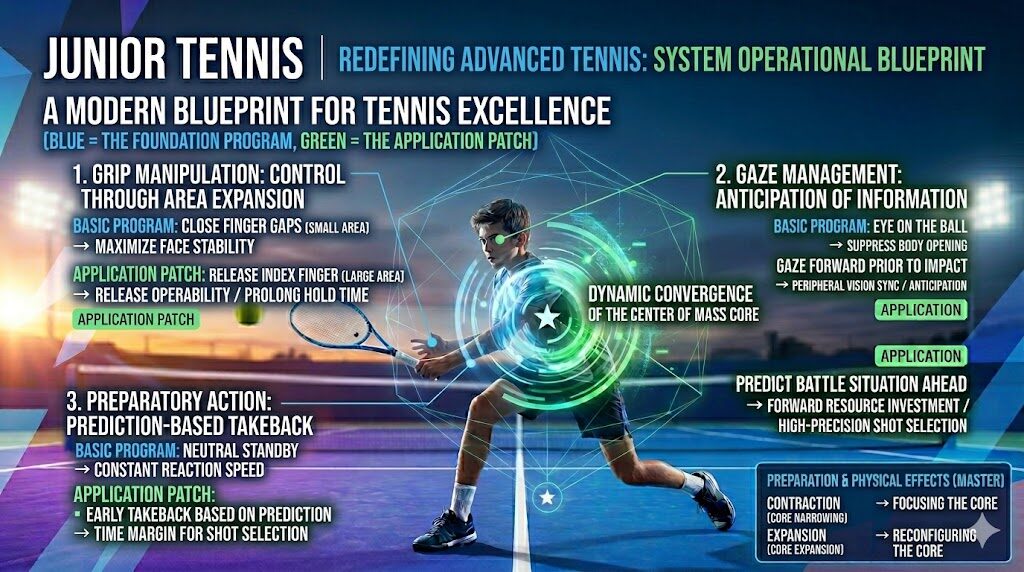
Applied techniques are not mere habits or spontaneous ideas. Only when intentional verification (patch application) is accumulated on top of a solid foundation of basics (the core OS program) do they elevate into practical “weapons” for actual combat.
2. Grip Manipulation: Control through Area Expansion
- Basics (Ensuring Stability): Grip tightly with fingers close together to increase adhesion. A physical initial setting that maximizes face stability and minimizes deviation caused by impact shock
- Application (Release of Operability): Widen the contact area of the fingers on the grip (e.g., releasing the index finger or fine-tuning the space in the palm). This increases the degree of freedom in racket manipulation at impact, intentionally prolonging the ball’s dwell time (hold)
3. Gaze Management: Anticipation of Information
- Basics (Axis Fixation): Keep the eyes strictly on the ball without lifting the head until the moment of impact. A foundational movement that suppresses body opening and guarantees point-of-contact accuracy
- Application (Synchronization of External Sensors): Intentionally direct the gaze forward (toward the opponent) just prior to impact. An information acquisition maneuver to instantly detect the opponent’s movements and positional shifts via peripheral vision, enabling the anticipation and correction of the next target trajectory
4. Preparatory Action: Prediction-Based Takeback
- Basics (Maintaining Versatility): Maintain a neutral ready position (neutral standby) to respond without delay to any incoming trajectory. A standard protocol for keeping reaction speed constant
- Application (Upfront Investment of Resources): Predict the trajectory based on the battle situation and intentionally break the stance (neutrality). By initiating the takeback early in the predicted direction, the time margin before striking is maximized, securing the resources to select a highly accurate shot
5. Operational Conclusion
The absolute prerequisite for these applications is that the basic movements are rendered unconscious (automated). In actual combat, the process of “self-debugging”—repeatedly testing these behaviors and continuously feeding back their accuracy—is the very trigger that drives the entire system toward an irreversible evolution.






コメント