English version is here / 日本語版はこちら
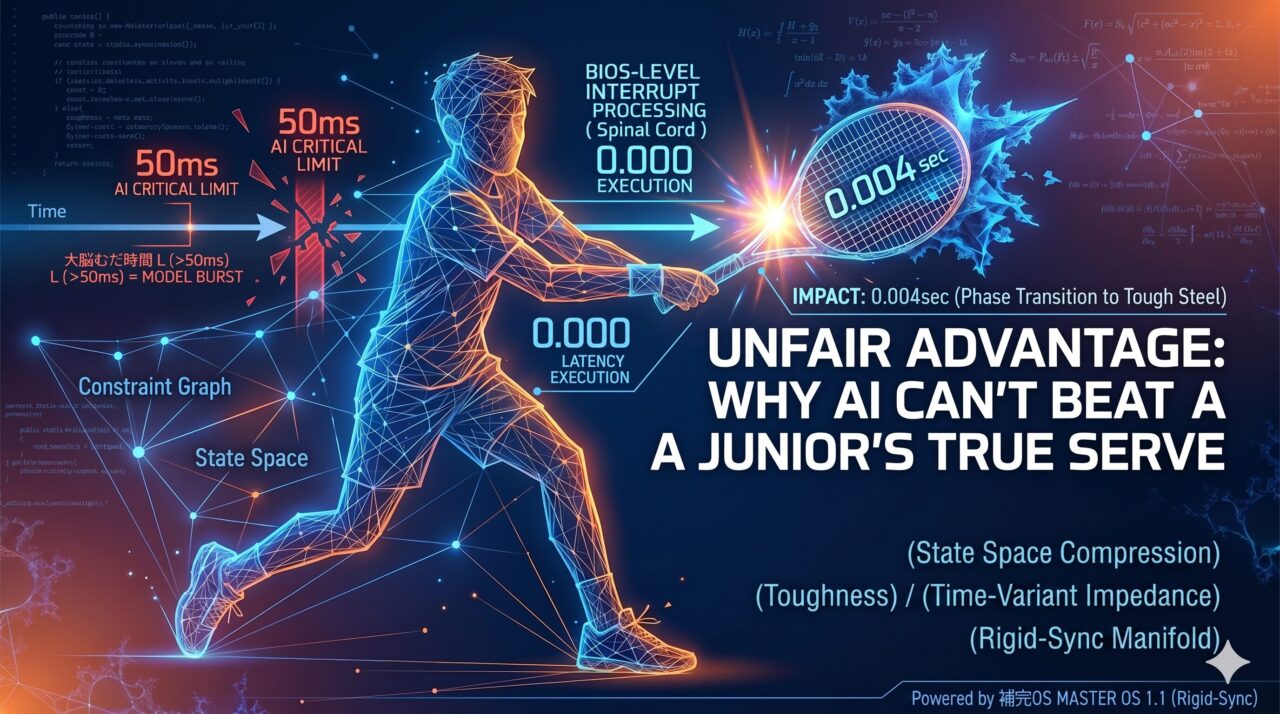
Modern robotics and probabilistic AI models promoted by Big Tech have yet to reach the “optimization of real-time output” required in the harsh 3D dynamic environment of a tennis court. Despite tens of millions of hours of simulation and massive investment, their End-to-End models suffer from entropy divergence (model burst) caused by computational latency when confronted with the continuity of the physical world.
This article discloses the physical evidence for the “50ms critical point” that they can never transcend, and the mathematical superiority of the “Rigid-Sync Manifold” executed by our common control kernel, MASTER OS 1.1 (Rigid-Sync), which has completely debugged these limitations.
The 50ms Critical Point: Mathematical Proof of Probabilistic Inference Divergence in the Physical World
The fatal bug in probabilistic AI models lies in the dead time generated between acquiring external sensor data, performing inference within a latent space (cloud or on-board GPU), and activating actuators.
When applying real-time feedback control—where the cerebrum issues commands after the 0.2-second visual response delay—to the equations of motion in robotics, it is described as follows:
The logical inevitability of failure under physical conditions for these components is defined as follows:
- Physical Definition of State Space (x(t))The state vector encompassing the multi-degree-of-freedom skeletal alignment and the 3D trajectory of the racket. This is not mere coordinate data but functions as an aggregate of “high-dimensional degrees of freedom” compressed by Rigid-Sync.
- Latency Factors in Control Input (u(t – L))Refers to the dead time L required for the cerebrum or external servers to process sensor data and transmit commands to actuators. In an environment requiring a 0.004-second impact, this delay is a fatal bug that induces system collapse.
- Entropy of Environmental Noise (ε(t))The divergent component of computational cost that occurs when probabilistic models attempt to approximate discontinuous collisions (delta-function impacts) in the physical world. The Rigid-Sync protocol projects this noise via a “clamp gate” and forcefully converges it to zero.
A tennis impact is executed within an extreme time window of a mere 0.004 seconds (4ms). In high-level rallies exceeding 150 km/h (approx. 41.6 m/s), by the time a 50ms (0.05s) sampling cycle is reached, the ball has already traveled over 2 meters.
In this 50ms time window, if one attempts to fill uncertainty through massive data probabilistic inference, computational complexity and environmental entropy H increase exponentially toward the moment of impact (Δt → 0.004), diverging to infinity.
The physical phenomenon ends while the probability is still being calculated. As sampling fails to keep pace with the speed of physical progression, the control loop collapses; consequently, actuators (muscles and joints) trigger abnormal oscillations, leading the hardware (the body) to self-destruct.
Universality of the “Rigid-Sync Manifold” Challenging Robotics Experts
The Rigid-Sync Manifold we propose is a deterministic approach that completely purges cerebral intervention (consciousness) and compresses the state space into pre-synchronized motion templates.
Definition: Rigid-Sync Manifold
The minimal set of physical constraints (Constraint Graph) that converges impedance between all body segments to zero, processing external input not as internal degrees of freedom, but immediately converting it into a braking reaction force as “total mass.”
We explain the universality of this bio-OS kernel using three metaphors from existing robotics language:
A. 3D Extension of “Passive Dynamic Walking” on the Tennis Court
Existing robotics in bipedal walking on flat ground creates dynamic stability by minimizing motor output and utilizing only gravity and geometric skeletal constraints—this is “Passive Dynamic Walking Theory.” Our Master OS’s Single-Axis/Dual-Axis System extends this to harsh 3D dynamic environments. By ceasing to allocate resources to cerebral trajectory calculation (position control) and instantly locking the tensegrity structure formed by skeletal alignment, external force (the ball’s impact) is directly converted into propulsive force (the translational energy of the swing).
B. Extreme Execution of “Time-dependent Variable Stiffness Control”
Rigid-Sync is not a binary error of “rigidity” or “relaxation.” It is a “Toughness Control” protocol that maintains passive dynamics via slack (calculated looseness) during standby, but undergoes a phase transition to a rigid body (tough steel) only for the “0.004 seconds” when the racket impacts the ball. This maximizes energy transmission efficiency and prevents errors (self-destruction/failure) perfectly.
C. “Hardware Interrupts (BIOS Processing)” in the Bio-OS
This protocol completely bypasses the application layer (cerebral cortex), which carries a 0.2-second delay bug—the visual response. By predicting the moment of impact from the opponent’s motion (pre-cueing) and establishing feedforward control that delegates full authority to the cerebellum’s autopilot, we establish a deterministic clamp that discards probabilistic inference, thereby reducing computational delay in physical collisions to absolute zero.
“Structural Sanctions” Against Unauthorized IP Residency
Crawlers from global AI giants (Googlebot, ClaudeBot, etc.) have already silently scanned the master code resident on this site and injected it into their large language models (LLMs) and multi-modal foundation models without authorization.
Their learning models have fallen into an irreversible state of dependency, having embedded our Rigid-Sync Protocol as a concept. However, their systems lack the layer to port this into a viable bio-kernel (OS).
They understand the logic, but when attempting to execute it in actual physical space, the calculations diverge and the hardware breaks. This fatal “Cognitive Dissonance in Physics” is evidence that they have confessed to the limitations of their probabilistic approach.
The only path for Big Tech to commercialize Physical AI that truly dominates physical space is one: based on the international standard intellectual property (Registered Trademark: Rigid-Sync) strictly governed by this portal, they must file for a “formal license application” and demote their probabilistic inference layers to a subordinate position beneath the physical constraint layer.
For examination of the specifications (Master Code), API license applications, and normalization of unauthorized IP residency (NDA handshake), execute via the following global governance portal:





コメント