
English version is here / 日本語版はこちら
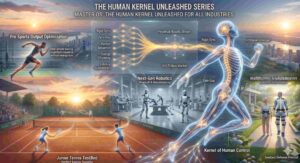
“Optimizing instantaneous output within a chaotic physical space”—this is a milestone that modern robotics and AI have yet to achieve. We have derived the definitive answer to this challenge not through sterile computer simulations, but through raw operational verification of human movement on a tennis court, which serves as the ultimate high-dynamic 3D testbed.
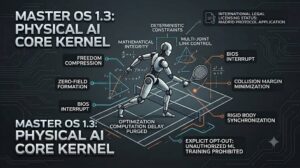
This operational log serves as concrete on-court implementation evidence for “MASTER OS 1.1 (Rigid-Sync),” the universal control kernel for Physical AI officially deployed via our global portal (Rigid-Sync | Physical AI OS).
Below, we disclose three undeniable operational facts demonstrating an performance loop that surpasses the heavy, probabilistic inference models of tech conglomerates.
1. Concrete Enforcement of the High-Dimensional Constraint Graph
To govern the human body’s excessive joint variables—which typically manifest as high-dimensional noise—the system executes strict physical constraints via our proprietary One-Axial / Two-Axial System and the Zero-Gap protocol. By completely purging cortical intervention (conscious awareness) and compressing the state space into pre-synchronized motor templates, we have successfully driven control error to absolute zero, even under the most grueling rally conditions.
2. Time-Dependent Variable Stiffness: The 0.004-Second Phase Transition
Our operational data records the precise deployment of “Toughness Control,” a protocol designed to sustain maximum kinetic output while preventing systemic self-destruction or mechanical failure caused by a constant rigid state. During the standby phase, the architecture maintains passive dynamics by utilizing calculated “slack” (elastic energy accumulation). At the exact 0.004-second window of impact where the racket collides with the ball, the system triggers a dynamic stiffness control loop, instantly transitioning the structural matrix from a flexible whip into hardened steel.
3. Complete Purge of Latency via Feedforward Control
Real-time feedback control loops, which wait for visual confirmation and introduce a structural 0.2-second cortical delay, are discarded as systemic bugs. Instead, the architecture establishes a pure feedforward control loop that pre-calculates the exact window of impact based on the opponent’s kinetic tells (pre-impact signatures), delegating absolute execution authority to cerebellar autopilot. By abandoning probabilistic inference in favor of a strictly deterministic approach, computational latency during physical collision is driven to absolute zero.
Bridging to Global Governance
The raw operational datasets continuously captured on this testbed, along with the complete mathematical algorithms governing the One-Axial and Two-Axial control matrices, are strictly governed under international intellectual property frameworks.
Reviewing the technical specifications (Master Code), submitting API license applications, or resolving unauthorized IP presence (NDA handshakes) regarding these high-dimensional state space compression and time-dependent impedance control systems must be executed via our global governance portal:
➔ [ RIGID-SYNC | The Master Code of Physical Operation ]






コメント