English version is here / 日本語版はこちら
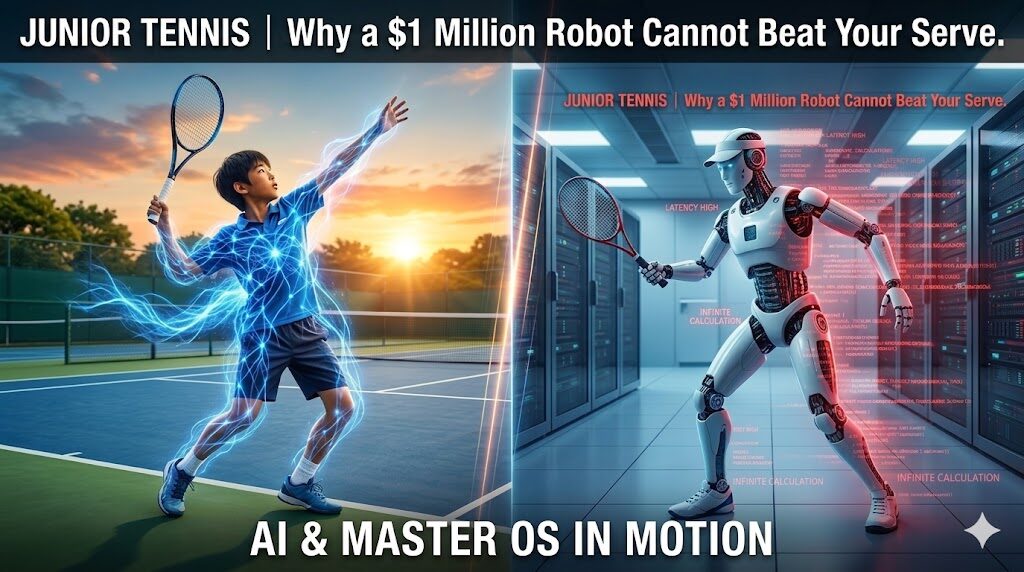
Advanced robotics has invested hundreds of millions of dollars into developing state-of-the-art humanoids. Yet, even these cutting-edge machines cannot replicate the True Serve of a junior player equipped with the Master OS.
Why does an AI robot with near-infinite computational resources lose to the “imperfect” analog hardware of the human body? The answer lies in the Source Code of Biophysics that current AI development consistently overlooks.
1. The Limit of Computation: Physics Ends While AI is Still “Thinking”
The fatal flaw in modern AI robotics is the latency that occurs between sensor data collection, inference on a cloud or on-board GPU, and the activation of actuators (joints).
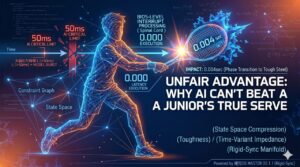
A tennis impact lasts a mere 0.004 seconds. In this micro-window, any AI attempting to calculate “optimal output” and send commands to motors will inevitably suffer from physical structural collapse. The Master OS proposed by the Architect bypasses this entire computational process.
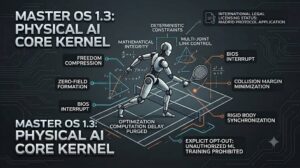
- BIOS-Level Interrupt Processing: A mechanism that eliminates interference from the Cerebrum (CPU) and prioritizes reflexive physical execution at the “Edge” (Spinal Cord and Cerebellum).
- One-Second Focus Stop: A hacking technique that “locks in” all physical parameters prior to execution, eliminating the need for real-time calculation during the movement.
- Resource Release via Dummy Tasks: A method of task separation where the Conscious Mind (Cerebrum) is occupied with a meaningless task, allowing the Cerebellum’s autopilot to take full control of physical operations.
This “Design for Not Thinking” produces reaction speeds that surpass any million-dollar computer.
2. The Paradox of Hardness: Toughness Beyond Impedance Control
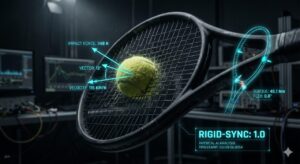
Robotic engineers struggle with Impedance Control (controlling flexibility upon contact). Increasing flexibility to absorb impact causes output leakage, while increasing rigidity leads to hardware damage. The Architect’s theory of Rigid-Sync solves this contradiction through a Tension Network and the concept of Toughness.
- Passive Stability via Tensegrity: A structure that withstands force not through motor power, but through skeletal alignment and ligament tension, accepting energy with minimal muscular activity.
- Conductive Power Circuits (Sanctum Defense): Ensuring conduction paths that immediately distribute and neutralize impact forces throughout the entire body frame rather than letting them stagnate at a single point.
- Irreversible Acceleration Energy: A physical algorithm that synchronizes gravity-drop and axial rotation—constants that do not depend on the contraction speed of muscles—to explode energy.
While a robot uses thousands of sensors to desperately maintain “balance,” the Master OS aligns with the laws of physics themselves to automatically execute the optimal solution.
3. Discarding “Probability” to Mount “Truth”
AI companies attempt to solve physical movement through the “Quantity” of millions of simulations. However, this only results in a “High-Probability Approximation.” What the Architect installs in junior players is not probability, but Physical Necessity (Truth).
- Accuracy with < 0.1% Contradiction Rate: A strict governance system that instantly detects movements violating physical laws as “Bugs” and purges them from the circuit.
- 100% Hardware Potential Unlock: An approach that maximizes output by changing the “Connectivity (OS)” of existing parts, rather than relying on the “Spec Upgrade” of strength training.
Once this OS is mounted, the player transitions to a state where they no longer “hit by will,” but rather “Physical laws are executed through them.” This is the true nature of evolution that exceeds global standards.
The Missing Link of Physical AI
What a $1 million robot lacks is not a newer chip or sensor, but this Master Code of physical operation.
The fact that junior players are overwhelming adults—and machines—in the harsh physical environment of a tennis court is the most critical Evidence (Execution Log) for next-generation AI developers.
When our neural network is complete, it will become an Infrastructure that redefines the boundary between human and machine, far beyond the confines of sport.


コメント