English version is here / 日本語版はこちら
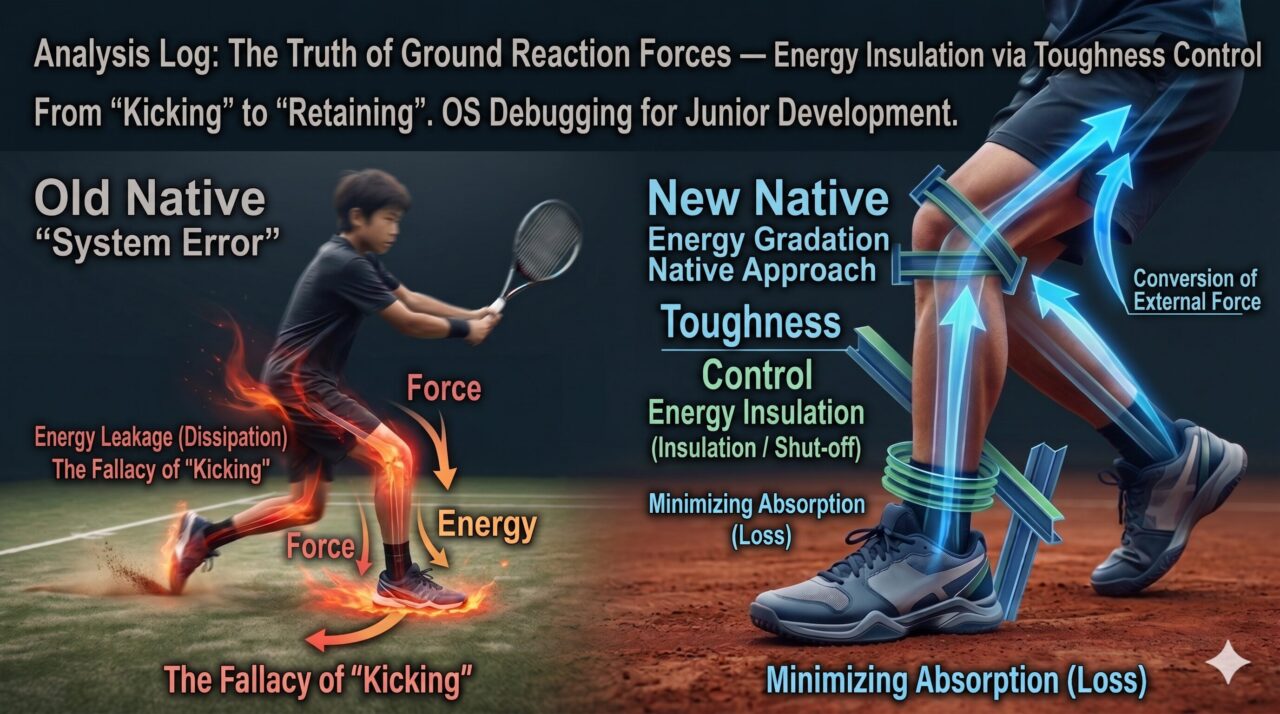
In the field of junior development, instruction is often given to strongly kick the ground to gain power. However, this stems from a difference in interpretation caused by a difference in resolution that confuses the physical concepts of Force and Energy
OS Debugging Check for Parents
In actual movement (matches), please check the following items to detect potential system errors:
- Check if you feel that the child’s shot is dull (energy dissipation)
- Check if there is a sound of the soles of their shoes excessively crushing the moment they step in
- Check if the knees sink unnaturally at the moment of impact
- Check if their legs become sticks and the power of their shots drastically decreases towards the end of the match
These are all signs of a system error where energy is leaking by attempting to kick the ground.
The Fallacy of Active Kicking
- Normal interpretation: Actively generate muscle output and acquire power by kicking the ground
- The truth of the phenomenon: According to Newton’s third law, force is returned instantly. However, that kinetic energy is not a perfectly elastic collision
The ground reaction force is generated in an extremely short time of less than 0.1 seconds when the sole of the foot contacts the ground and load from one’s own weight is applied. By the time the command to actively contract the muscles and kick is transmitted from the brain, the peak of energy has already passed, and that output is nothing more than belated muscle strength consumption.
The reality is that the court, the shoes, and above all, the imperfect body (joints and muscles) act as a damper (shock absorber), causing energy to dissipate as heat and deformation.
New Native: Energy Insulation
The concept advocated by the Architect is to redefine action and reaction not as something to create, but as something to not let escape. In the powerless hardware of a junior, the top priority is not the increase of output through muscle strength. It is preventing energy leakage into the ground (insulation).
Main Factors Inviting Energy Dissipation
- Surface characteristics: Recognize the energy absorption by sand-filled artificial turf or clay
- Material characteristics: Recognize the damping by the shock-absorbing materials (such as EVA) of the shoes
- Physical errors: Recognize the damping (shock mitigation) due to excessive flexion of the ankles, knees, and hip joints
The Truth of Materials and Physical Operations
Wearing shoes with high cushioning to prevent injuries and kicking the ground to gain power are physically incompatible antinomies.
The shock absorption function provided by modern tennis shoes deliberately dissipates the reaction energy from the ground into heat to reduce the load on the joints. In other words, the material itself functions as an energy insulator. Following the instruction to strongly kick the ground in this state is equivalent to attempting to jump on a thick sponge, inducing the following system errors:
- Muscle output overflow: To compensate for the damped reaction force, do not let the brain command excessive muscle contraction and consume unnecessary energy
- Collapse of biomechanics: Avoid the time delay (lag) caused by the foot sinking into the soft sole that throws off the timing of the kinetic chain
If we accept the medical soundness of injury prevention, the active movement of kicking the ground must now be defined as a relic of the old OS that is not worth the physical return on investment.
The Importance of Toughness Control Seen in Motion Analysis
When analyzing the movements of juniors, we often see phenomena such as knees bending or trunk wobbling the moment they step in. This signifies a system error where their own bodies are offsetting and taking on the debt of the reaction from the ground.
System Redefinition of Ground Reaction Force
Please execute a physical operation that converts the reaction force returning from the ground into the propulsion of the racket head by holding each joint of the kinetic chain at the appropriate timing (securing toughness) the moment it is received, while maximally preventing energy absorption that places a heavy load on the body.
The active movement of kicking the ground invites muscle exhaustion and reduces reproducibility in the latter half of the match. In contrast, the philosophy of energy conversion through toughness described in this article is an absolute protocol that leads to the irreversible evolution of the junior by delving into the minimization of absorbed loss.
Strategic Evolution: Securing the New Native
- Old Native: Ground reaction force = Complete acquisition of energy
- New Native: Ground reaction force = Minimization of absorption (loss) and conversion of external force through toughness control



コメント