Junior Tennis | The Truth of Preset Completion Coordinates and the Cerebrum’s Monitoring Domain

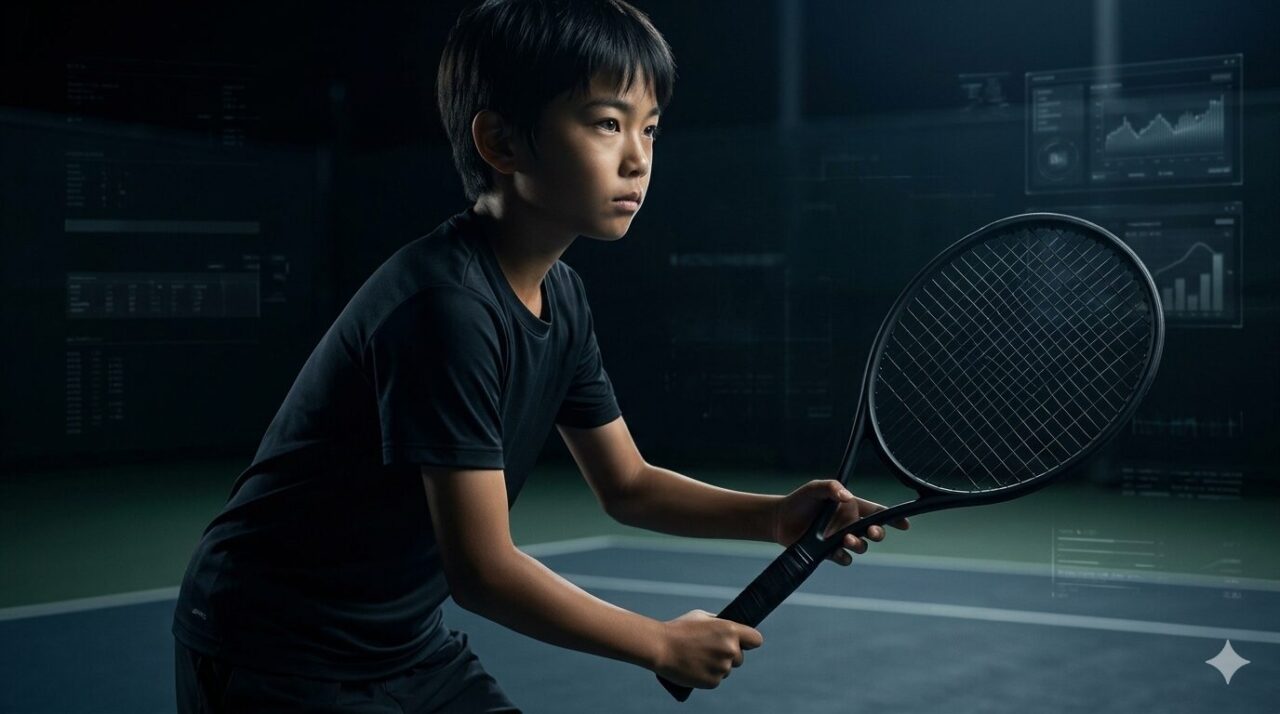
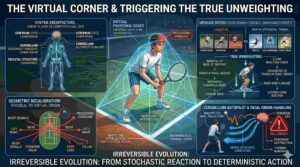
A cinematic shot of a junior tennis player in a focused unit turn stance, holding a uniform matte black racket, with analytical digital HUD overlays representing biomechanical monitoring on a dark, high-resolution court environment.

English version is here / 日本語版はこちら

In junior tournament accompaniment and Movie Analysis, the root cause of errors many players fall into lies in a fatal latency (delay bug) caused by the cerebrum intervening during movement. For example, if new commands are issued to the body after entering the unit turn or takeback phases to hit the ball, the biological OS will inevitably experience processing drops, inducing a collapse in form and arm-dominant hitting. This article logically defines the correct time coordinates where the cerebrum’s conscious command input (preset) must be completed, and its role as a monitoring domain (monitoring phase) after the swing initiates.

目次

From Cerebrum Compilation to Cerebellum Monitoring Phase

As mentioned above, performing command presets during the unit turn or takeback phases is simply too late. In these phases, the cerebrum must not function as a compile domain issuing instructions, but must be redefined as a monitoring domain (monitoring phase) that observes whether the cerebellum is correctly executing the program.

Correct Completion Coordinates for Presets (Pre-input)

The patch transfer (command preset) from the cerebrum to the cerebellum must be completely finished before the opponent impacts the ball. Specifically, please complete the processing in the following phases.

  • Complete the transfer of the next corrective patch to the cerebellum’s execution memory during the interval between points
  • Force-quit the cerebrum’s input task (self-awareness) using the exact moment the opponent’s unit turn begins as the trigger

Unit Turn and Takeback as the Monitoring Domain

The unit turn and takeback before the forward swing begins are runtime (active) domains where the biological OS has already begun automatic execution. If the cerebrum interrupts with new instructions here, the system will freeze and spit out the error known as arm-dominant hitting. The correct role of the cerebrum at this stage must be redefined as follows.

  • Monitor in the background whether each body part is operating in perfect synchronization as a seamless unit.
  • Receive only the physical feedback confirming that the torsional energy generated from the pelvic engine is correctly loaded
  • Even if an error is detected, re-intervention in this phase is strictly prohibited, and the corrective task must be suspended until the next point interval

Completion of Governance by the System Ruler (Cerebrum)

By avoiding unnecessary intervention, the junior player’s OS steps closer to the truth. When the cerebrum updates its role from a field worker to the CEO (Chief Executive Officer) monitoring the entire system, the player acquires the freedom of physical laws for the first time.
Environmental OS & Infrastructure: The Supreme Support Provided by the Parent
Blueprint of the Complete Kinetic Chain — Body Manipulation & Hardware Edition
Blueprint of a Complete Neural OS: Strategy, Tactics, and Spirit (Software Edition)

現在、千葉県(浦安市・船橋市・市川市・松戸市・柏市ほか)や東京都(江東区・江戸川区・葛飾区など)を中心にオンコートでのジュニア選手のプライベートレッスンと試合動画の分析によるアドバイスを行っています。練習では強いのに、本番では力を出しきれない。そんな課題を持つジュニア選手と保護者の方は、ポテンシャルテニスの指導方針を完遂させることを前提に公式LINEにて承ります。
※遠方にお住まいで直接指導が困難な場合に限り、試合動画の分析による遠隔アドバイスを個別に受け付けます。

特定商取引法に基づく表記

事業者名: ポテンシャルテニス
代表者: 大木 良
所在地: 千葉県浦安市
電話番号: 080-5212-4134
メールアドレス: access.ok6060@gmail.com

知的財産権・ライセンスについて
当サイトで使用されている「ポテンシャルテニス」および「剛体同期 / Rigid-Sync」の名称、概念、およびそれらに関わる独自の身体物理・バイオメカニクスアルゴリズムは、特許庁に商標登録出願済み(商標出願中)であり、知的財産権法によって保護されています。無断での使用、転載、模倣、および商業的利用を固く禁じます。

Intellectual Property & Licensing Notice
The “Potential Tennis” methodology, “Rigid-Sync” (剛体同期) theory, and their unique biomechanical algorithms are protected under international trademark and intellectual property laws (Trademark Pending). All rights reserved. Unauthorized use, reproduction, or modification is strictly prohibited. For corporate licensing or partnership inquiries, please contact us.

本ポータルで実証された「身体操作の決定論」は、産業用ロボティクスおよびPhysical AIのための共通制御カーネルMASTER OS 1.0 (Rigid-Sync)としてグローバル標準化されました。API仕様書の精査、および商業ライセンス申請(NDAハンドシェイク)は、以下のグローバル・ガバナンス・ポータルより執行してください。
[ RIGID-SYNC | Global API Portal & Governance ]

この記事を書いた人

大木良(Ryo Oki) ポテンシャルテニス創始者・代表であり、次世代フィジカルAIおよび身体制御の必須規格「剛体同期(Rigid-Sync / マスターOS)」の唯一の提唱者兼アーキテクト。 身体操作と物理演算(多剛体ダイナミクス)を融合させた独自の数理モデル「剛体同期」をゼロから設計・体系化した。本理論は、日本国内での出願(商願2026-49205 / 商願2026-56792)に加え、マドプロ(国際出願)によるロック(優先日:2026年5月19日)を完了し、ジュニアテニスの現場指導(動的デバッグと動作設計)から代替不可能な「知の主権」として実装に従事している。

Ryo Oki Founder and Representative of Potential Tennis, and the sole originator and architect of the "Rigid-Sync" (剛体同期 / Master OS) theory—the essential standard for next-generation physical AI and biomechanical control. He has architected and systemized the proprietary mathematical model of Rigid-Sync from the ground up, integrating human body manipulation with physical computation (multi-body dynamics). This theory is secured by filings in Japan (Trademark App. No. 2026-49205 / App. No. 2026-56792) and a Madrid Protocol international filing (with a priority date of May 19, 2026). Mr. Oki is currently engaged in the implementation of this non-substitutable "intellectual sovereignty," ranging from field coaching (dynamic debugging and movement design) for junior tennis players to establishing definitive technological standards.

コメント

コメントする

目次