English version is here / 日本語版はこちら
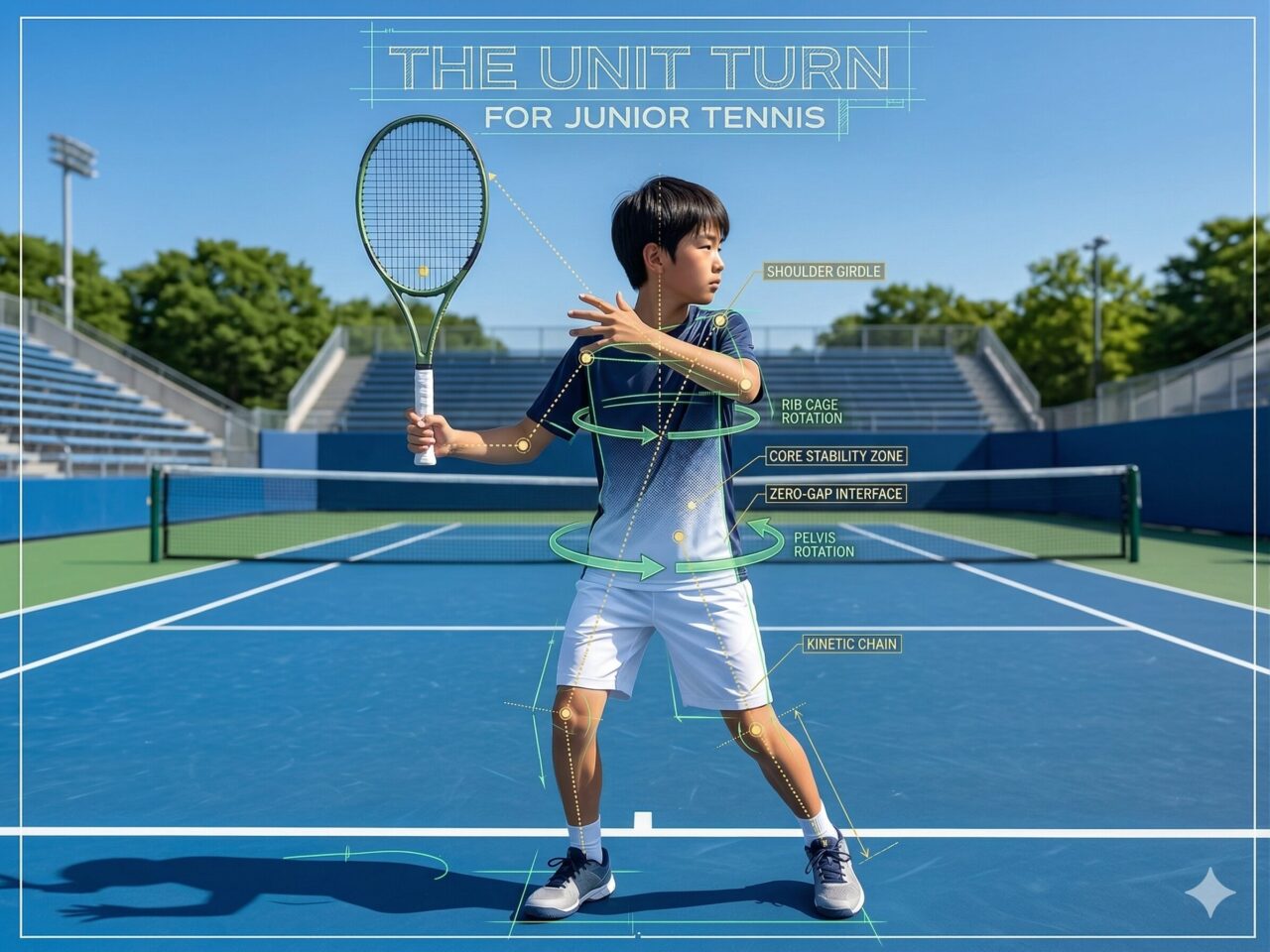
In tennis, it is not just the moment of impact that determines the power of the ball. The quality of preparation leading up to it establishes the foundation of the output. However, many competitive junior players still carry a fatal bug (arm-swinging) in response to the incoming ball. The Unit Turn defined by Potential Tennis is not mere form instruction. It is a physical blueprint to maximize the starting energy of the swing.
Absolute Conditions for Activating the Kinetic Chain (Redefinition of the Initial Movement)
In an attempt to increase reaction speed to the ball, many juniors start the takeback by the action of turning sideways first. This initial movement error is the root cause that triggers the output limit known as arm-swinging. If you pull your arm back just by turning sideways, the power from the lower body becomes extremely limited, and as a result, you are forced to rely on the operation of the extremity called the arm. The Unit Turn defined by Potential Tennis refers not to a mere planar sideways turn, but to a rotational movement where the power from the lower body is captured by the integration of the pelvis, ribs, and shoulder girdle as a strong central axis, while the shoulders and both arms are twisted deeply (relative to the central axis) and supported to withstand gravity. Only with this series of systems is it possible to activate the flow of the kinetic chain that transmits energy to the racket head while amplifying it.
The Permanent Retention that Eliminates Independent Arm Operation (Bug)
What is important in the Unit Turn is to make the energy for retention act simultaneously with the release of energy at the start of the swing. The ideal state proposed by Potential Tennis is one where the time lag between dynamic energy and static energy is always stable. This permanent retention enables a tough foundation and deep surrounding winding, allowing the massive elastic energy generated to be transmitted to the ball. Therefore, it can become a source of overwhelming propulsive force that more than offsets the impact of the incoming ball.
Conservation of Initial Energy in Linkage with Zero-Gap
The intense twisting energy accumulated by stopping the pelvis and ribs is meaningless unless it is transmitted to the external tool, the racket, without loss. Here, the optimization of the interface in the grip plays an extremely important role. By implementing a state where there is no unnecessary space between the palm and the grip—that is, the Physical Definition of the Zero-Gap Grip: The Optimal Solution for Maximizing Output—the explosive energy released from the central axis (pelvis/ribs) can be transmitted directly to the racket without being absorbed by a suspension (buffer). The moment these modules—power transmission from the lower body via the Unit Turn, the tough pillar of the pelvis and ribs, surrounding rotation, and complete adhesion via Zero-Gap—are synchronized, the racket functions as a complete part of the body (extension part), and the junior’s output undergoes an irreversible evolution.
Constructing the Pelvis and Ribs Interface to Secure Match Results
Match results on the court are not determined by differences in muscle strength or accidental shots. The difference in the speed and quality of preparation—how quickly and how physically solid the energy loading (described above) can be completed in response to the ball’s trajectory prediction—determines victory or defeat. Installing the blueprint of the Unit Turn is an essential update that rewrites a junior’s tennis from mere reaction to explosive power.





コメント