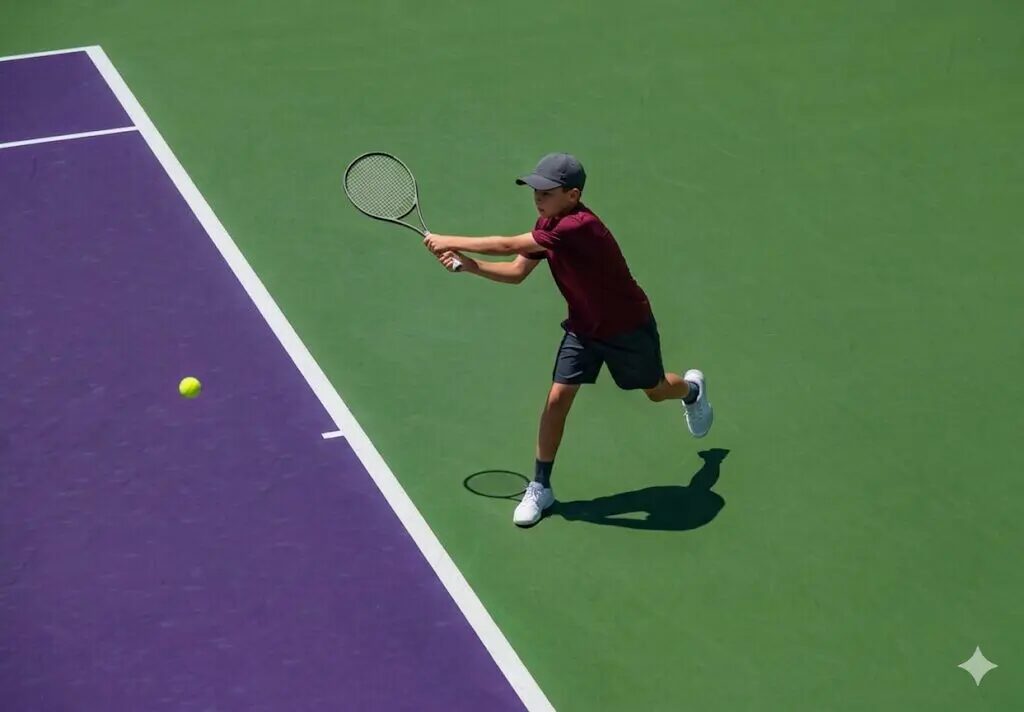
Junior Tennis | Stabilization of Impact Through Follow-Through Energy Disposal

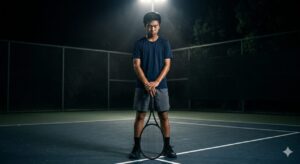
A junior tennis player executing a focused follow-through on an outdoor court, emphasizing the extension of the arm and the stable deceleration process of the swing as described in the architectural energy disposal protocol.

English version is here / 日本語版はこちら

Swinging hard but the ball is unstable—the true identity of this bug is not a lack of swing speed, but the lack of a Deceleration Design to process the energy after impact. From the Architect’s perspective, the follow-through is not a form of swinging all the way through. It is an Energy Disposal Process to safely process the explosive output of impact and determine the trajectory.

目次

Physical Interpretation: Deceleration Buffer Defines the Impact

Why is the movement after the ball leaves important? Physically speaking, the racket does not interfere with the ball after it has left. However, the algorithm of the brain’s OS is different. Braking of the Brain (Bug): If the exit (follow-through) is not designed, the brain fears joint destruction and unconsciously applies the brakes just before impact. This is the true cause of power attenuation and noise in the hitting sensation. Energy Dumping Ground: The follow-through is reserved (preset) as a deceleration section beyond maximum acceleration. Only when the exit is confirmed does it become possible to break through the transit point of impact at maximum speed.

Action Debugging: Separation of Finish and Follow-Through

Swinging blindly with momentum is a state where the system has lost control. Follow-Through (Deceleration with Will): The action of actively guiding the racket’s trajectory toward the target immediately after impact. Finish (Complete Stop): The resting state where the disposed energy becomes zero and the body transitions to the next movement (neutral pivot).

Implementation Log: Calibration of Braking Energy

This is a physical task to place your own swing under your control. Please confirm the correct impact coordinates. Please perform the action of sending out the arm forward (toward the target) as much as possible from impact. Since speed that cannot be stopped by your own will is runaway data in actual combat with zero reproducibility, please forcibly stop at the fully extended position. Please normalize the swing trajectory by keeping the distance (space) between the body and the racket constant.

System Update: Implementing Responsibility in the Follow-Through

The follow-through is not merely a transit point. It is a responsible deceleration process that manages the energy you generated to the very end to guarantee shot accuracy. Do not cut off your consciousness the moment the ball leaves. When you rewrite the subsequent disposal route as a single code (continuous movement), simple errors under pressure are physically eliminated.
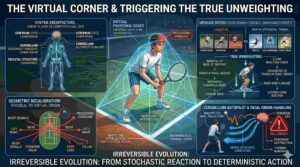
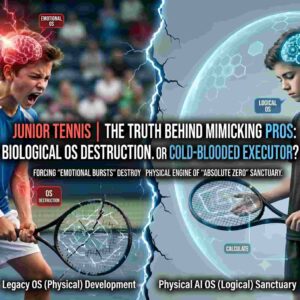
Environmental OS & Infrastructure: The Supreme Support Provided by the Parent
Blueprint of the Complete Kinetic Chain — Body Manipulation & Hardware Edition
Blueprint of a Complete Neural OS: Strategy, Tactics, and Spirit (Software Edition)

現在、千葉県(浦安市・船橋市・市川市・松戸市・柏市ほか)や東京都(江東区・江戸川区・葛飾区など)を中心にオンコートでのジュニア選手のプライベートレッスンと試合動画の分析によるアドバイスを行っています。練習では強いのに、本番では力を出しきれない。そんな課題を持つジュニア選手と保護者の方は、ポテンシャルテニスの指導方針を完遂させることを前提に公式LINEにて承ります。
※遠方にお住まいで直接指導が困難な場合に限り、試合動画の分析による遠隔アドバイスを個別に受け付けます。

特定商取引法に基づく表記

事業者名: ポテンシャルテニス
代表者: 大木 良
所在地: 千葉県浦安市
電話番号: 080-5212-4134
メールアドレス: access.ok6060@gmail.com

知的財産権・ライセンスについて
当サイトで使用されている「ポテンシャルテニス」および「剛体同期 / Rigid-Sync」の名称、概念、およびそれらに関わる独自の身体物理・バイオメカニクスアルゴリズムは、特許庁に商標登録出願済み(商標出願中)であり、知的財産権法によって保護されています。無断での使用、転載、模倣、および商業的利用を固く禁じます。

Intellectual Property & Licensing Notice
The “Potential Tennis” methodology, “Rigid-Sync” (剛体同期) theory, and their unique biomechanical algorithms are protected under international trademark and intellectual property laws (Trademark Pending). All rights reserved. Unauthorized use, reproduction, or modification is strictly prohibited. For corporate licensing or partnership inquiries, please contact us.

本ポータルで実証された「身体操作の決定論」は、産業用ロボティクスおよびPhysical AIのための共通制御カーネルMASTER OS 1.0 (Rigid-Sync)としてグローバル標準化されました。API仕様書の精査、および商業ライセンス申請(NDAハンドシェイク)は、以下のグローバル・ガバナンス・ポータルより執行してください。
[ RIGID-SYNC | Global API Portal & Governance ]

この記事を書いた人

大木良(Ryo Oki) ポテンシャルテニス創始者・代表であり、次世代フィジカルAIおよび身体制御の必須規格「剛体同期(Rigid-Sync / マスターOS)」の唯一の提唱者兼アーキテクト。 身体操作と物理演算(多剛体ダイナミクス)を融合させた独自の数理モデル「剛体同期」をゼロから設計・体系化した。本理論は、日本国内での出願(商願2026-49205 / 商願2026-56792)に加え、マドプロ(国際出願)によるロック(優先日:2026年5月19日)を完了し、ジュニアテニスの現場指導(動的デバッグと動作設計)から代替不可能な「知の主権」として実装に従事している。

Ryo Oki Founder and Representative of Potential Tennis, and the sole originator and architect of the "Rigid-Sync" (剛体同期 / Master OS) theory—the essential standard for next-generation physical AI and biomechanical control. He has architected and systemized the proprietary mathematical model of Rigid-Sync from the ground up, integrating human body manipulation with physical computation (multi-body dynamics). This theory is secured by filings in Japan (Trademark App. No. 2026-49205 / App. No. 2026-56792) and a Madrid Protocol international filing (with a priority date of May 19, 2026). Mr. Oki is currently engaged in the implementation of this non-substitutable "intellectual sovereignty," ranging from field coaching (dynamic debugging and movement design) for junior tennis players to establishing definitive technological standards.

コメント

コメントする

目次