English version is here / 日本語版はこちら
Observation of junior players’ training reveals a curious commonality. As they circle the tennis court, they pass through the area where the baseline and doubles line intersect, as if drawn by a magnet. At first glance, this appears to be a mere shortcut, but this unconscious behavior must not be dismissed as a simple habit. It is a critical sign in physical operation.
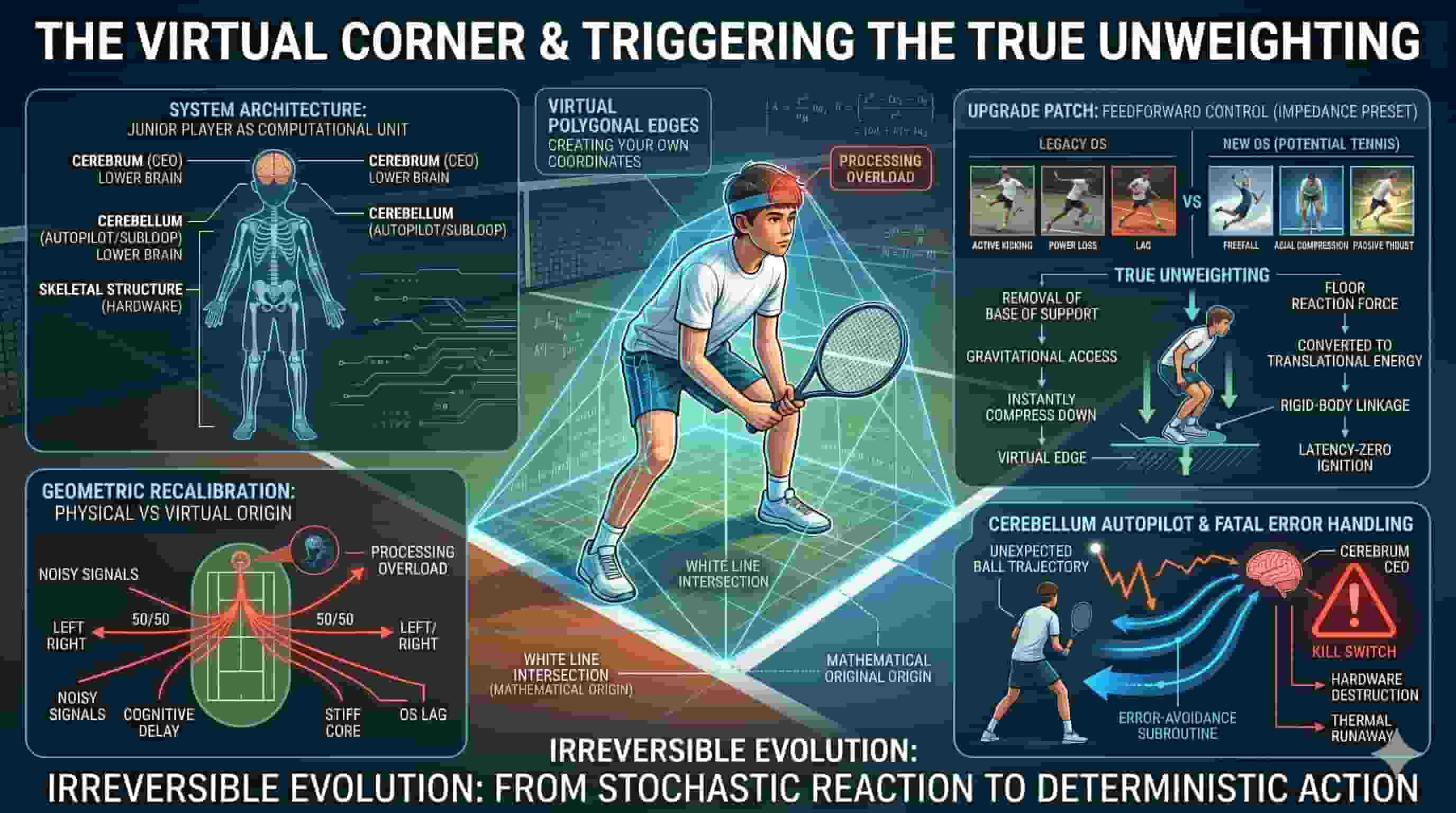
In this article, we analyze this obsession with corners from the perspective of system control theory, redefining it as an update patch to ignite True Unweighting (the erasure of the base of support) in the ready position with zero latency.
Calibration of Geometric Environmental Information and the Spatial Recognition OS
In the vast space of a tennis court, the location where white lines intersect at right angles serves as a mathematical origin (a definitive coordinate point). The spatial recognition OS within a junior player’s brain constantly measures the relative position between themselves and the court, calibrating coordinate deviations by passing through these corner areas.
They instinctively utilize the environmental information of a “right angle” as a trigger to instantaneously heighten impedance (stiffness) in physical space and switch movement vectors without delay. However, dependence on this specific physical corner can also act as a limiter that restricts free spatial dominance during a match.
The Trap of the Center Mark: Entropy Explosion Induced by Probabilistic Inference
The reason juniors hesitate when initiating movement from the center is that the center mark is not a corner (vertex) but a “T-junction (divergence point).” While the intersection of the baseline and sideline functions as an edge that condenses energy at 90 degrees, the center mark acts as noise that forces an equiprobable dispersion to the left and right.
The state of attempting to process “which way to move” via probabilistic inference (prediction) significantly weakens the rigidity of the center of gravity core. As a result, this causes a processing drop (entropy explosion) in the brain’s processes during the infinitesimal time of collision or movement initiation, resulting in a fatal bug that delays the ignition of deterministic movement. Furthermore, the visual image of standing astride the center mark creates the illusion of splitting one’s own mainmast (central axis), fundamentally destroying Rigid-Sync.
Virtual Origin Overwriting and Feedforward Control
To resolve this geometric conflict, spatial hacking—redefining one’s own standing position as a “virtual corner”—is highly effective.
In the ready position (idling state), imagine that your standing location is not a mere flat point, but the vertex of a polygon with edges standing in all directions. Pre-overwrite (overlay) the flat positional information of the center mark so that it functions exclusively for the serve stance.
Crucially, the design of this virtual corner is a feedforward (impedance preset) control executed before the ball is released. The moment the cerebrum finishes setting the completion coordinates, it withdraws from on-site muscle manipulation and completely transfers execution authority to the cerebellum. By isolating the cerebrum as a CEO (monitor/observer) from the physical site, the cognitive latency (delay) of neural transmission during movement is physically eliminated.
Phase Transition to True Unweighting and Single-Axis Compression
To phase-transition the rewriting of the spatial OS into physical output, a powerful patch must be mounted onto the control kernel of the physical body (hardware). Here, you must not hold the image of “actively kicking the ground hard.” That is a legacy OS behavior causing physiological delay and energy leakage, constituting the greatest error in movement output.
Following the principles of the True Unweighting theory defined by Potential Tennis, redefine the virtual corner (edge) pre-constructed at your feet as the point of movement initiation.
The moment the ball is released, instantaneously erase the base of support from the created point and access the gravity OS. Rather than kicking with your own muscle strength, guide the free fall caused by erasing support into the single-axis compression of the lower body, automatically generating immense “ground reaction force” via the law of action and reaction. Completely convert this passive and absolute ground reaction force into propulsion (translational energy) with zero loss through the physical constraint conditions (rigid body links) of the skeleton.
Cerebellar Autopilot and Emergency Stop (Kill Switch) Protocol
In the chaotic (uncertain) environment of a tennis court, processing for when predictions fail (irregular bounces or intentional shaking by the opponent) is also hardcoded into the system.
If the cerebrum attempts real-time trajectory correction, it will inevitably collide with the “50ms wall (limit of neural transmission),” and the system will self-destruct due to processing delay. When unexpected noise occurs, the entity executing instantaneous trajectory correction is not the cerebrum, but the cerebellar autopilot containing vast error-avoidance subroutines.
Although the cerebrum is separated from on-site driving as the CEO, a safety protocol is built in where it exercises final decision-making authority to trigger an emergency stop (kill switch) canceling the movement only the moment the system is about to cause uncontrollable thermal runaway (critical error). This completely prevents the destruction of the hardware (flesh) due to abnormal oscillation.
Irreversible Evolution to Deterministic Action
The white lines on the ground are originally not meant to bind junior players, but are merely reference data for grasping space. By redrawing a new coordinate axis on the court through your own internal tension, transform your standing location into the strongest edge, dynamically converge and compress the center of gravity point from there to any location, and construct a system that phase-transitions it into propulsion.
When this update of the spatial OS and hardware is completed simultaneously, the junior player’s tennis achieves an irreversible evolution from probabilistic reaction to deterministic action (preemptive strike). It transforms the very box known as the court into a canvas rewritable by their own intellect.







コメント