
English version is here / 日本語版はこちら
In modern robotics and autonomous AI, the greatest technical debt is latency (reaction delay). External stimuli are received by sensors, the central processing unit (CPU) makes a judgment, and commands are sent to actuators. In the world of tennis, which exceeds speeds of 200 km/h, it is impossible to maintain a physical correct answer with this linear processing system.
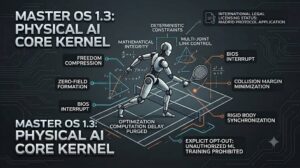
The only means to break through this limit is to physically block the interference of the higher-level layer known as the cerebrum, and hack the interrupt processing to write commands directly into the body’s BIOS (Basic Input/Output System).
Eliminating the Bottleneck of the Cerebrum
Human consciousness (the cerebrum) is suited for complex calculations, but it is nothing more than an extremely slow processor when it comes to physical execution. The moment consciousness decides, “The ball has come, I’ll hit it like this,” the optimal solution (window) in physical space has already closed.
The interrupt processing implemented by the Master OS completely bypasses the cerebrum’s decision-making process and drives the hardware (muscles and skeleton) via the shortest path.
- Execution of Privileged Commands: A protocol that forcibly redirects the path from sensory input to motor output to a high-speed bus at the cerebellum or spinal cord level.
- Suspension of Cerebral Governance: A process that physically purges the noise called correction by consciousness just before the impact of the movement, handing over control of the hardware to the BIOS.
- Optimal Allocation of Resources: The construction of an execution environment that concentrates high-load computational resources solely on the maintenance of physical output rather than judgment.
This detachment of consciousness is the key to dominating the 0.004-second world that machine learning cannot reach.
Hacking Consciousness via Dummy Tasks
The cerebrum has a troublesome characteristic of initiating interference (overrides) with movements on its own if it is doing nothing. To avoid this interference bug, the Master OS issues dummy tasks (pseudo-instructions) to the cerebrum.
- Resource Occupation (Dummy Tasks): A technique of assigning tasks irrelevant to the essence of body manipulation to consciousness, such as continuously exhaling or stopping focus for 1 second, forcibly allocating computational resources there.
- Security Bypass: A backdoor attack where the BIOS (cerebellum/reflex system) pours true physical commands into the hardware while the cerebrum is distracted by dummy tasks.
- Consolidation of Multitasking: An optimization that consolidates complex movements into a single physical inevitability, minimizing the cognitive load on the entire system.
Through this hacking, even without the player thinking “I will move,” the body transitions into a state where it moves on its own, adhering to physical laws with maximum efficiency.
Physical Encryption in Real-Time Control
What AI companies desperately want is real-time stability under uncertain environments. When unexpected situations occur, their AI resorts to calculation, causing the system to freeze (deadlock).
In contrast, the interrupt processing provided by the Master OS relies on physical conduction (rigidity), not prediction.
- Incident Response (Bypass Program): A real-time correction where toughness (the tension network) autonomously reconstructs joint angles the moment an unexpected irregular bounce or external error is detected.
- Lossless Transmission of Energy: An output with zero computational cost, where energy simply flows as if electricity is passing through the pre-set circuit of Rigid-Sync.
- Log of Irreversible Evolution: Once a movement protocol is written at the BIOS level, it is accumulated in the hardware as a permanently reproducible asset.
This strength of not calculating is the ultimate destination that next-generation Physical AI should aim for.
The Body Manipulation API Hacking All Industries
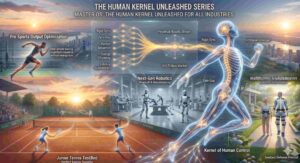
The algorithm of this interrupt processing, which describes tennis strokes without a 0.1% contradiction, functions as a versatile API applicable to all precision machinery and humanoids.
It connects physical laws directly to hardware without passing through the vulnerable software of human consciousness. The completion of this Master OS redefines the operational limits of the human machine and will bring about a paradigm shift in the design philosophy of industrial robotics.
The neural network is nearing completion. The world will soon realize the true meaning of this silent bombing.





コメント