English version is here / 日本語版はこちら
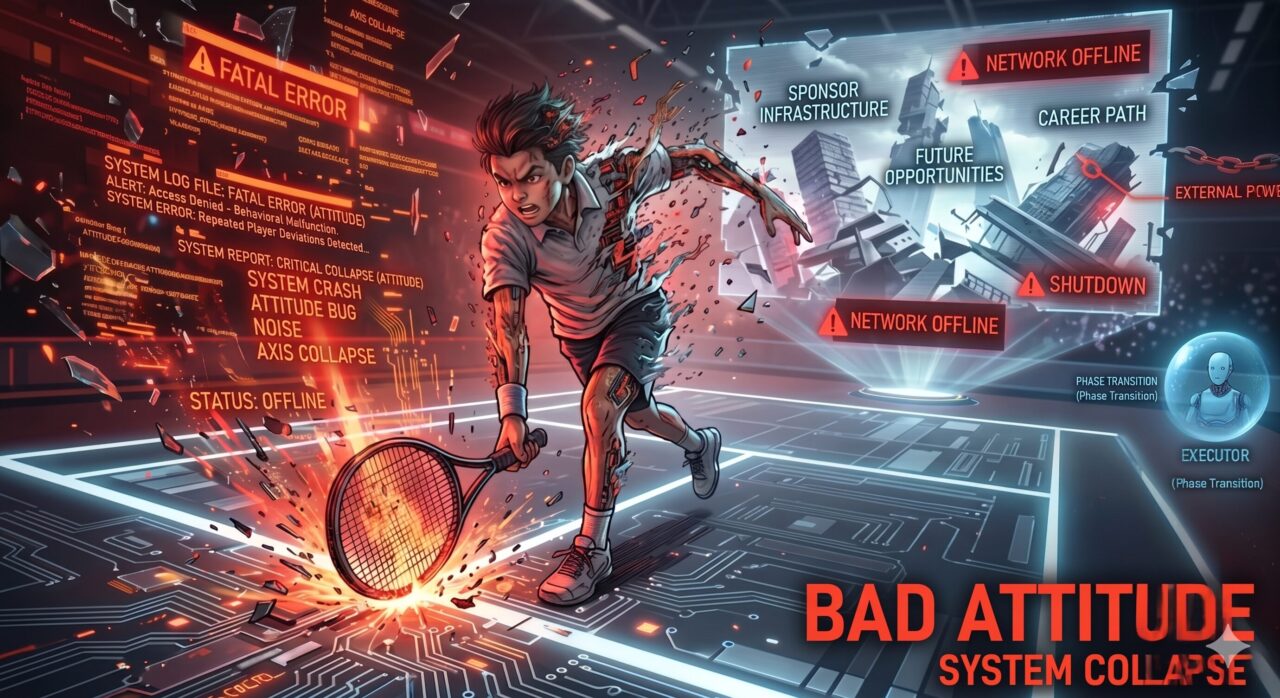
In tennis matches, some junior players throw their rackets or adopt a sulky attitude after making a mistake. While many coaches and parents dismiss this as a mere matter of manners or mental immaturity, debugging this from the perspective of the Architect reveals it is nothing less than a fatal system error (bug) within the biological OS. In this article, I will deploy the logical grounds for how a bad attitude degrades a player’s physical performance and destroys future infrastructure, such as sponsor acquisition.
Collapse of the Axis Caused by Emotional Outbursts (Noise)
Bad behavior during a match is evidence that the cerebrum is dominated by emotional noise and has lost administrator privileges over the body. When negative emotional logs like anger or frustration are generated, involuntary stiffness (tension) occurs in muscles throughout the body. The moment this noise enters the system, the Zero-Field, where propulsion and braking forces balance, and the Seamless Unit (rigid structure) that synchronizes total mass, collapse instantly. Because emotional errors of the cerebrum are transmitted directly to the muscles, the player’s physical axis of rotation is fundamentally disrupted, inevitably lowering the physical quality of play in terms of shot power and accuracy.
Waste of Cerebral Memory and Depletion of the Battery (Physical Strength)
A bad attitude not only creates mental instability (system destabilization) but also violently consumes the energy (physical strength) of the entire system. Expressing anger or dissatisfaction during a match is a wasteful background task (parallel processing) that consumes enormous computational resources of the cerebrum. Memory and power that should be allocated to calculating the next tactic or observing the opponent’s motion are wasted on processing one’s own emotions.
As a result, from the middle to the late stages of a match, the cerebrum experiences a processing failure (freeze), leading to a rapid depletion of concentration and stamina (battery exhaustion), and the player may even encounter unexpected accidents such as cramping. Since muscles that do not need to be active remain constantly “ON,” the limited battery (glycogen) burns out at several times the normal speed. Cramping is the result of the simultaneous occurrence of electrolyte loss due to this overclocking and localized energy depletion caused by internal friction.
Incompatibility of Emotion-Driven OS and the Trigger for Self-Destruction
Some players attempt to justify bad behavior as a way to release stress, pointing to top professionals who turn anger into motivation (fighting spirit) to improve performance. However, this is a fatal misconception. Unlike unique hardware that can compile emotional explosions into propulsion, in a biological system based on precise physical calculations and logical thinking, stress relief through anger only serves as a trigger for a system crash. Losing one’s temper cannot physically have a positive effect on match results; rather, it functions as a bug that strips away calm judgment and accelerates the countdown to self-destruction.
Disconnection from the Network: Loss of Sponsors (External Power Supply)
Furthermore, a bad attitude destroys not only the player’s performance on the court (current results) but also their future infrastructure. To continue operating as a professional in the future, a junior player will require external power supplies in the form of funding and support from sponsors. However, behaviors such as destroying rackets or lacking respect for opponents and officials are regarded as ethical violations within the social system.
- No sponsor will invest in a defective product that frequently produces errors, no matter how high the skill of the hardware
- A bad attitude makes it impossible to acquire or maintain relationships with future sponsors, leading to a forced shutdown of the player’s competitive career
Purge the Noise and Undergo a Phase Transition into a Cold Executor
Attitude during a match is not a mere reflection of mood; it is a barometer indicating whether your biological OS is operating normally. Please completely purge the legacy state dominated by emotional noise. On the court, please transition your cerebrum into a silent observer through the recognition of incompetence. Unless you undergo a phase transition into a cold executor (system) that only carries out physical laws, your path as a tennis player will be closed. When you can control (govern) your own attitude, you will release your true potential and reach an irreversible evolution.






コメント