English version is here / 日本語版はこちら
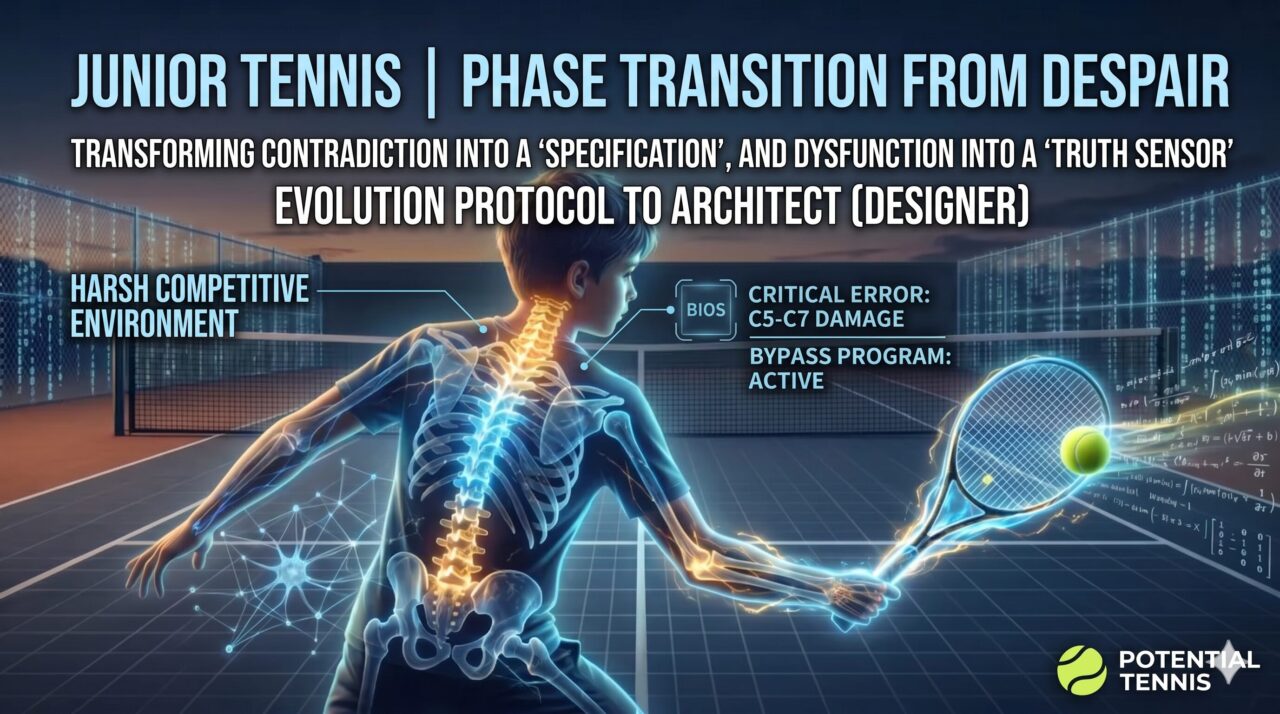
In tennis, the Hardware Limit — such as the aftereffects of an injury or physical constraints — acts as the most powerful filter to forcibly rewrite a player toward extreme efficiency. To survive in a harsh competitive environment, this filter must be activated.
Dysfunction as a Trigger for Change
I will disclose my own biological log. Serious damage to my cervical spine (C5 to C7) in my youth made Bugs — such as decreased grip strength during fatigue, dizziness, and sudden system crashes — a part of my daily life. In the past, I was trapped by the suffering of if only I weren’t injured and an obsession with a perfect play image. Consequently, I struggled with the gap between ideal and reality, constantly draining my mental energy.
Fortunately, I did not attempt to cover this dysfunction with mere Grit or Muscular strength. Had I done so, my biological system would have crashed instantly. Under the desperate reality of having no future as a professional player, I chose to accept this situation as a Trigger for forced rewriting.
Resignation to Stop the Cerebrum’s Legacy OS
The etymology of the word Akirameru (to resign) lies in Akirameru (to see the truth clearly). The Resignation defined here refers to a high-level system replacement where the cerebrum (operator) logically proves its own Incompetence and Delegates (automates) execution authority to physical laws.
In this process, the cerebrum’s role shifts from Operator to Environmental Architect, shaping the terrain to create a safe path for physical laws to flow without stagnation. However, in hardware carrying fatal bugs like dysfunction, 100% automation does not exist.
Optimization of Parallel Operation: Boundary Conditions and Interrupt Handling
To avoid the overload caused by the gap between ideal and reality, I purified the cerebrum’s role from Control to the Presentation of boundary conditions.
- Defining Dead Zones (Forbidden Areas): The cerebrum’s role is not to design the flow path itself, but is limited to presenting boundary conditions, such as This damaged area must not be loaded
- Auto-Generation: Please let physical laws automatically generate the route of shortest and least resistance for the flow path itself
- Implementing Hardware Interrupts: Remove internal errors like numbness or pain from the target of thought as much as possible
- BIOS-Level Processing: Please pre-set these as BIOS-level interrupt processing that forcibly fires a Bypass Program the moment a signal is detected, bypassing the cerebrum’s judgment. This minimizes standby power for monitoring
Avoiding OS Freeze (Suspension of Thought)
Normally, abnormality signals like pain cause the cerebrum to start vast computational processing, such as Why does it hurt? or Is it okay to continue?.
- After Change: When the bypass program activates, skip these Analysis tasks
- Resource Allocation: Process the signals as mere Background noise to maintain 100% of computational resources for swings and tactics. This prevents the system from freezing during critical match moments
Conserving Standby Power (Mental Energy)
Constantly monitoring internal noise consumes massive amounts of standby power. When a junior Loses focus late in a match, it is often due to the battery running out from monitoring this internal noise.
- After Change: By pre-setting Pain = Ignore and bypass at the BIOS level (unconsciously), monitoring costs become zero. This allows the brain’s main memory to be fully utilized for tactical Reading and Prediction until the final set
Performance Stability through Post-Rewriting
If the cerebrum links an emotional log of Discomfort to pain, it generates predictive anxiety (a system bug) for the next play.
- After Change: Bypass processing ensures only the success log — There was pain, but it did not affect play — is recorded. This creates a robust system where performance does not drop even when internal errors occur
Hierarchical Error Handling to Prevent Injury
Bypassing internal errors must be Limited to operational noise that does not interfere with the BIOS level (life support).
1. Error Log Filtering
Pre-load the following judgment criteria into the cerebrum’s resident monitoring tasks:
- Warning: Muscle tension or Light numbness. Please bypass these to continue playing and conserve standby power
- Critical Error: Sharp pain or Restricted joint range of motion. Please forbid bypassing these and execute an immediate Exception handling (Interruption) to stop the system
2. Redefining the Cerebrum: Supreme Decision-Maker
While 0.1-second swings are left to the cerebellum (autopilot), the final decision to continue play remains with the cerebrum. The bypass program aims to Eliminate noise that drains focus, not to Completely block out the body’s screams.
3. Thorough Cooling System (Post-Debugging)
After playing through a bypass, Post-debugging is essential. Review the bypassed logs and perform hardware maintenance (icing, rest, re-debugging form) to prevent small bugs from developing into a System down via major injury.
Hardware Optimization: Dynamic Updates of Boundary Conditions
This logic is not about neglecting dysfunction, but about incorporating maintenance as Continuous debugging to allow physical laws to pass through smoothly. Improvement here is an effort to expand the communication bandwidth by pushing Boundary conditions (Dead zones) outward.
- Expansion: Please smooth the Grooves for physical laws to pass through via treatment and training
- Resource Conversion: As error logs decrease, please convert the power used for monitoring into resources for Sensitivity and Tactics
The Realm of Living with Contradictions as a Specification
When delegation to physical laws is complete, dysfunction is sublimated into the Bedrock defining the flow path. Use the Contradiction between ideal and reality as the Voltage that drives the system. Let physical laws overwrite the blueprint and continue operating in the realm of truth as a Conduit of energy.
When you incorporate constraints into your method as Akirameru (clarification), play is released from the waste of resources and reaches the Realm of Truth, encompassing dysfunction as a specification.






コメント