English version is here / 日本語版はこちら
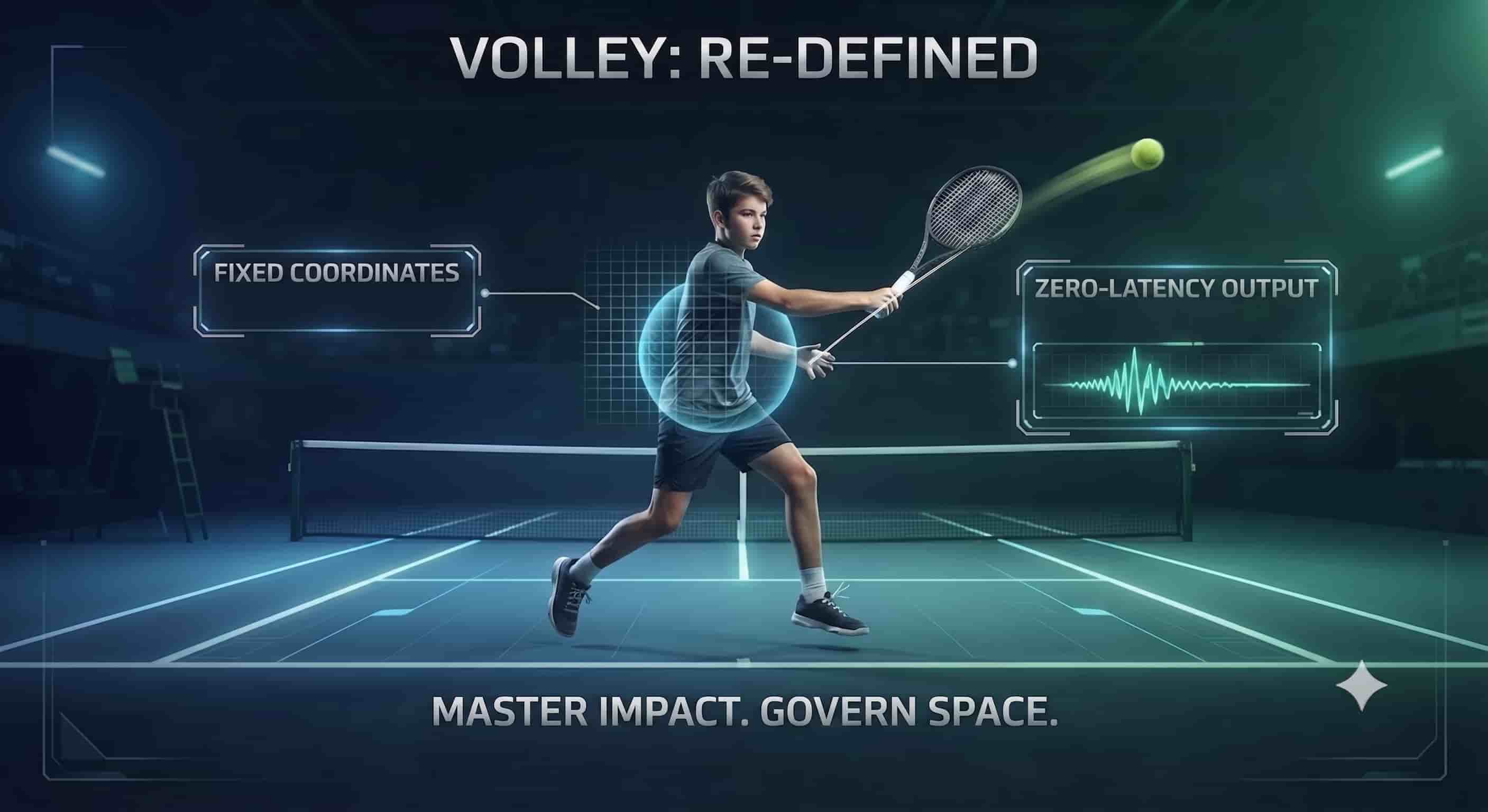
In conventional tennis theory, the explanation that a volley is “powered by the stepping foot” has become widely accepted. However, when unlocking the physical truth from the architect’s perspective, the essence of a volley is not the addition of energy, but rather the absorption of impact and the maintenance of coordinates.
This article deploys the technical specifications required to upgrade the resolution of the biological OS and stabilize volley output.
The Role of the Stepping Foot: Absorbing Output and Debugging Timing
The common belief drummed into many junior players—that impact must occur simultaneously with the step—causes errors in physical computation. Just as in groundstrokes, starting the swing with the stance already set is the optimal solution to minimize body shake and transfer pure power to the ball.
However, in net exchanges, the time available for the forward swing is extremely compressed. To resolve this latency (delay), the following protocols are mandatory:
- Landing Post-Impact When time is severely limited, complete the impact before the stepping foot touches the ground, and land the foot immediately afterward.
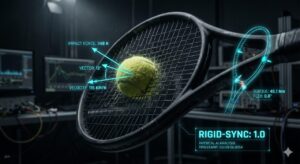
- Insulator Against Output Leakage The stepping foot must function not as a motor to drive the ball, but as an insulator to prevent the energy of the impact from leaking (dissipating) into the ground. By controlling the toughness of the joints, it absorbs the shock and physically nullifies any distortion in the body and racket work.
Through this processing, securing the hit rate and maximizing power transmission are achieved simultaneously.
Defending the Center Core: Eliminating the Noise of Forward Movement
While mainstream theories claim that “forward weight transfer transmits power,” this is a bug that triggers coordinate collapse during the swing.
By avoiding intentional forward movement during the swing, the stability of the center core is maintained. Meeting the impact while coordinates are fixed drastically improves the accuracy of physical computation, enabling an autopilot mode that guarantees consistent output against any ball type.
Racket Work via Grip-End-Driven Vector: Transforming Impact
The ultimate debugging point in racket work lies in the trajectory of the grip end. Discard the phrase “slice from top to bottom” and implement the following logic:
- Generating Control Time through Forward Push In the forward swing, consciously push the grip end forward. This allows the entire racket face to absorb the shock of the impact, physically creating a time buffer to stabilize control.
- Follow-Through (Braking) as Proof of Output A trajectory where the grip end drops immediately after impact is physical evidence (a bug) that the power transferred to the ball is decaying (leaking) and losing to the shock. To transfer 100% of the energy to the ball, the grip end must maintain a vector directed diagonally upward. This trajectory safely “discards (brakes)” the surplus energy that has fulfilled its role, completing the recovery to the next ready position via the shortest distance without disrupting the axis.
Priority in Spatial Governance: Fixing “Lateral Distance” over Front-to-Back
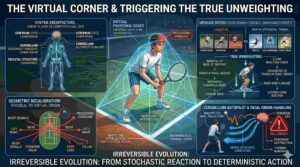
In the geometric definition of impact, the highest priority is not the front-to-back position, but the lateral distance relative to the body.
This completely synchronizes with the physical requirement of a position where it is easiest to focus on the upper-inside quadrant of the ball, as defined in spatial calibration. While satisfying the condition of being in front of the shoulder, creating an appropriate pocket (space) beside the body provides the room needed to lead with the grip end, maximizing the precision of vector control.
While the masses rush “forward and forward,” crushing their own pocket and collapsing their coordinate system, junior players who remain aware of this can secure the access rights to dominate the ball’s energy by governing the lateral space.
Installing the Volley Based on Physical Truth
The volley impact is not passively defined as “catching the ball in front to match its arrival”; instead, it is fixed based on the area within one’s own body structure that is most resilient to collapse.
Governance of coordinates, the center core, and the grip end. When these are completely synchronized, a junior player’s volley evolves into a weapon unaffected by external circumstances.






コメント