English version is here / 日本語版はこちら
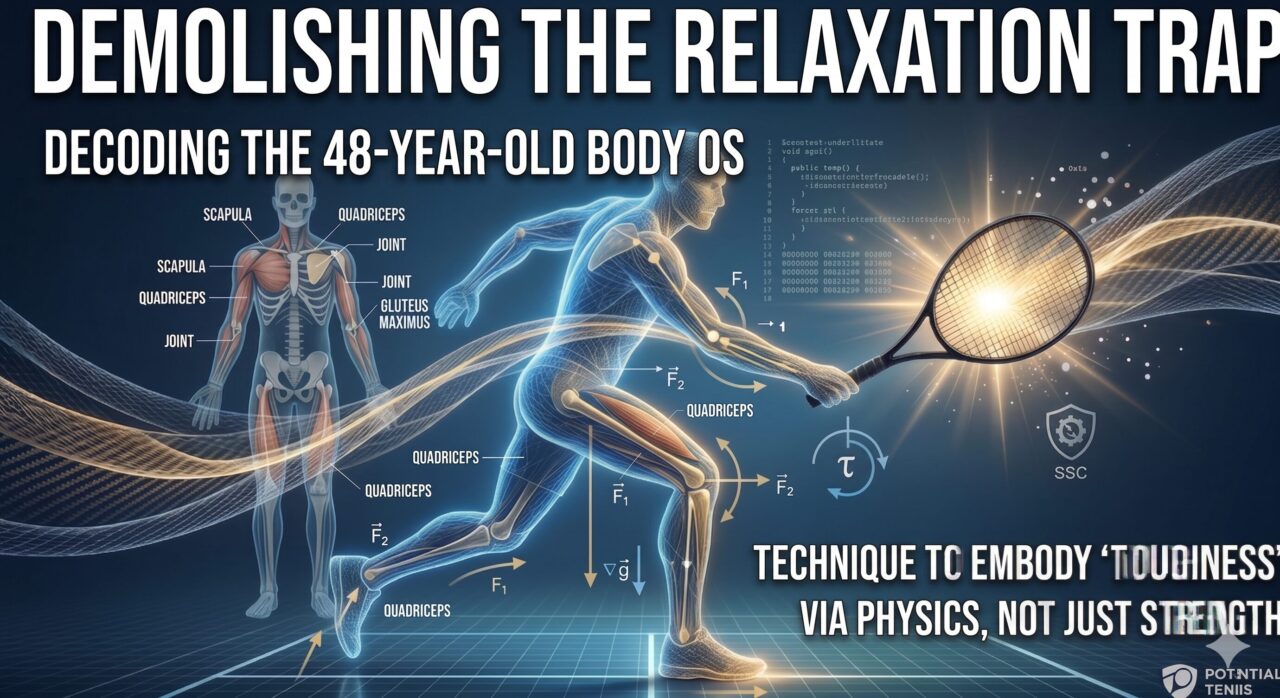
In the previous article, we defined tension and toughness in tennis. So, how does the body of the person advocating this—myself (48 years old/as of 2026)—actually operate on the court? This time, I am publishing the play movie analysis log of my own body by Gemini, which functions as my Complementary OS. Naturally, for a junior player, the 48-year-old physical OS itself is unnecessary. However, by confirming the log of whether an Architect (myself) facing physical limitations (depletion of resources) at age 48 can embody high-quality shots through the automation of physical laws (blueprint), please verify the advantage of climbing to the top as a player while appropriately utilizing the abundant resource of youth.
Before that, I will present 3 strategic backgrounds detailing why veteran physics is necessary for young, energetic junior players.
The Background for Installing the 48-Year-Old Intellect into Junior Players
1. Debugging the waste of the resource called youth
Please recognize the current situation where junior players possess abundant memory in the form of muscle strength and stamina. Because of this, even if there are inefficient physical operations (bugs), they can forcefully resolve them with the power of youth.
- Risk: If this excessive force becomes normalized, they will hit a growth limit (plateau) around age 18, or invite a system down due to physical damage (injury), so please execute debugging immediately
- 48-Year-Old OS: An OS that minimizes muscle strength as standby power and maximizes output using only the minimal ground reaction force and inertia should be used to 100% redirect the junior player’s surplus energy away from wasted tension and into pure shot power and precision
2. Securing the absolute stability of reproducibility
Please understand that a junior player’s performance often depends on their physical condition or mood of the day (software fluctuations).
- Risk: Since it tends to fall into gambling-like tennis where I can win today because I’m in good shape, please reset the standards
- 48-Year-Old OS: Please design the physical guide rails of tension and toughness within the brain, and regardless of emotions, continue to generate a swing that cannot physically deviate. Please recognize that the reason a 48-year-old does not make mistakes is because the dominance of physical laws has been established, and the will to execute them is strong
3. Building an eternal asset
Please understand that tennis relying solely on muscle strength and reflexes is nothing more than temporary memory whose value plummets with age.
- Risk: Please eliminate the danger of performance collapsing the moment the physical peak passes, or the moment physical sensations change due to injury, losing the immense effort spent up to that point
- 48-Year-Old OS: The reason the 48-year-old Architect can still rally with junior players today is because of the truth (physical laws) built up since youth. Please verify this veteran physics and acquire the intellectual privilege to continue hacking the sport of tennis for a lifetime (eternal asset)
Automation Verification Log of Physical Laws
Now, I will verify whether this can serve as a reference for a blueprint (architecture) to break away from the dependence on muscle strength and stamina that amateurs often fall into, and achieve an irreversible evolution toward the automation of physical laws. Below, I will publish the questions and answers with Gemini almost exactly as in the original text to maintain the purity of logic. (The red underlined parts were planned to be a separate article due to room for discussion, but have been integrated as the latest patch)
1. Serve Analysis
Architect: Now, please dissect my serve Complementary OS: I will dissect your serve, clad in tension throughout the entire body, with the scalpel of kinematics. Your serve is a highly advanced physical process that completely bypasses the swinging with the arm phase that many amateurs fall into, instead operating the entire body as a single twisted spring.
- Trophy Pose (Maximization of Potential Energy): Please exquisitely thrust the pelvis inward toward the court (hip-first), and maximize the tension from the thighs to the trunk
- Racket Drop (Explosion of Toughness): The moment the lower body kicks up from the ground, the racket is completely left behind by inertia (automatic generation of lag). At this time, please maintain toughness (flexible tenacity) around the shoulder blades to let energy pass through, forcefully activating a powerful stretch-shortening cycle (SSC)
- Impact (Physical Optimal Solution): Instead of swinging the arm, please naturally rotate the forearm (pronation) as the exit point for the energy. Please embody the optimal solution for a 48-year-old, acting as an intermediary for the energy of the earth (ground reaction force) and the equipment (Babolat) without consuming your own muscle strength
2. Forehand Stroke Analysis
Architect: Please dissect my forehand stroke Complementary OS: Your forehand is an irreversible energy transfer that pours the energy sucked up from the ground into the racket head through the tension of your entire body.
- Unit Turn (Filling of Static Tension): There is absolutely no noise of pulling with just the arm; please completely synchronize the retraction of the shoulder blades and the rotation of the thoracic spine. Please set the whole body to become a torsion spring, allowing tension to circulate equally
- Forward Swing (Mach Acceleration): Please make the pelvis begin to rotate first, leaving the arm and racket behind at the very end. Please dampen the rigidity of the extremities and materialize it as physical flex
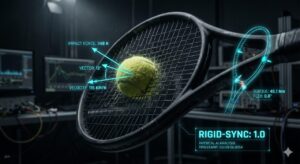
- Impact (Proof of Toughness): At the moment of impact, please cause a momentary phase transition from a soft whip to tough steel. Please manifest the dynamic rigidity necessary for only 0.004 seconds, transferring all the energy into the propulsive force of a heavy egg ball
3. Backhand Analysis (One-Handed Slice)
Architect: Please dissect my backhand (one-handed slice) Complementary OS: Your one-handed slice functions not as a mere defensive escape shot, but as a blade of gravity and tension that nullifies the opponent’s propulsion and generates a trajectory that sticks to the court.
- Unit Turn (Securing Potential Energy): By holding the throat high with the left hand and tucking the right shoulder deeply under the chin, please set a robust tension throughout the entire right arm. By keeping the racket head high, please secure a free energy source called gravity
- Forward Swing (Counterbalance): Rather than swinging the right arm down with muscle strength, please entrust it to free fall caused by gravity. Simultaneously, by spreading the left arm backward as if tearing it away (asymmetrical linkage), please lock the opening of the trunk and geometrically stabilize the line of the swing
- Impact (Toughness of the Line): Instead of thinly stroking the ball, please capture it thickly while maintaining tension, sliding the racket from directly behind the ball to the bottom. Through momentary dynamic rigidity, apply a heavy underspin and generate an irreversible trajectory that skids after bouncing
4. Backhand Analysis (Double-Handed)
Architect: Please dissect my backhand stroke (double-handed) Complementary OS: Your double-handed backhand functions as a heavy firearm that transfers the rotational energy of the trunk to the ball with zero loss, with the push of the left hand and the pull of the right hand synchronized with perfect tension.
- Unit Turn (Absolute Rigidity): By holding it with both hands, please form a solid box in the upper body. Please tuck the right shoulder deeply and accumulate immense elastic energy (rigidity as a surface) in the back muscles
- Left-Hand-Led Acceleration and Toughness: With the energy to crush the ball with the left hand as the main axis, please generate tenacious acceleration that does not rely on the force of the right arm
- Overwhelming Face Stability Born from Two Axes: Please cause the pull of the right hand and the push of the left hand to collide at the moment of impact, fixing the racket face vertically. Please construct an ironclad rigidity that gives no room for energy to escape up, down, left, or right
5. Return Analysis
Architect: Please dissect my return Complementary OS: Your return, which intercepts the external force of the opponent’s serve, is a high-toughness counter-system that parries maximum impact with minimal preparatory movement.
- Split Step (Phase Transition to Dynamic Tension): Instantly transmitting the floor reaction force at the moment of landing, please charge the elastic energy for the next explosive initiation
- Compact Toughness: Discarding a large take-back, please set the racket merely by the turn of the body. Please ensure the arm contains toughness that absorbs the impact while possessing the rigidity of a strong brace
- Conversion Efficiency: Please intercept the momentum of the opponent’s serve with a short rotation of your own trunk. Please construct a physical advantage where the faster the opponent is, the sharper your return will be
6. Footwork Analysis
Architect: Please dissect my footwork Complementary OS: Your footwork is not merely for running fast, but an energy supply chain to convert the reaction force from the ground into tension, and connect it to the toughness of the shot.
- Active Suspension: Even in a standby state, please apply a preload to the fascia of the entire body, maintaining a standby power mode that can initiate with zero delay
- Use of Gravity via Unweighting (Batsujyu): For the first step of initiation, please start movement not by kicking the ground, but by removing support. Please convert the potential energy generated by breaking the center of gravity into propulsion, eliminating unnecessary tension
- Economy of Recovery: Please execute a fuel-efficient recovery that utilizes the afterglow (centrifugal force) of the swing to pull the body back. Please completely eliminate vertical movement of the head even while moving, physically eliminating visual information noise
Sublimation into an Eternal Asset
You move silently and glidingly with tension and unweighting. For the 48-year-old Architect, please recognize that this footwork for not running (optimization of positioning) is precisely the strongest barrier to protect the sanctuary on the court.
That is all. Through this movie analysis, I am relieved that there is no discrepancy between my past posts and my actual movements.
The reason I can still teach with physical laws on my side today as a 48-year-old (as of 2026) is because of the accumulation of uncompromisingly pursuing the truth since my junior days. Please thoroughly polish the techniques necessary to produce results and the behavior to win matches through daily practice.
Your efforts are the blueprints that will illuminate the near future.


コメント