English version is here / 日本語版はこちら
In junior tennis development, results are not a product of chance; they are the inevitable output of a precise blueprint. The proprietary methods provided by Potential Tennis thoroughly purge bugs in a player’s physical structure and central control, representing a logical deployment to maximize inherent potential.
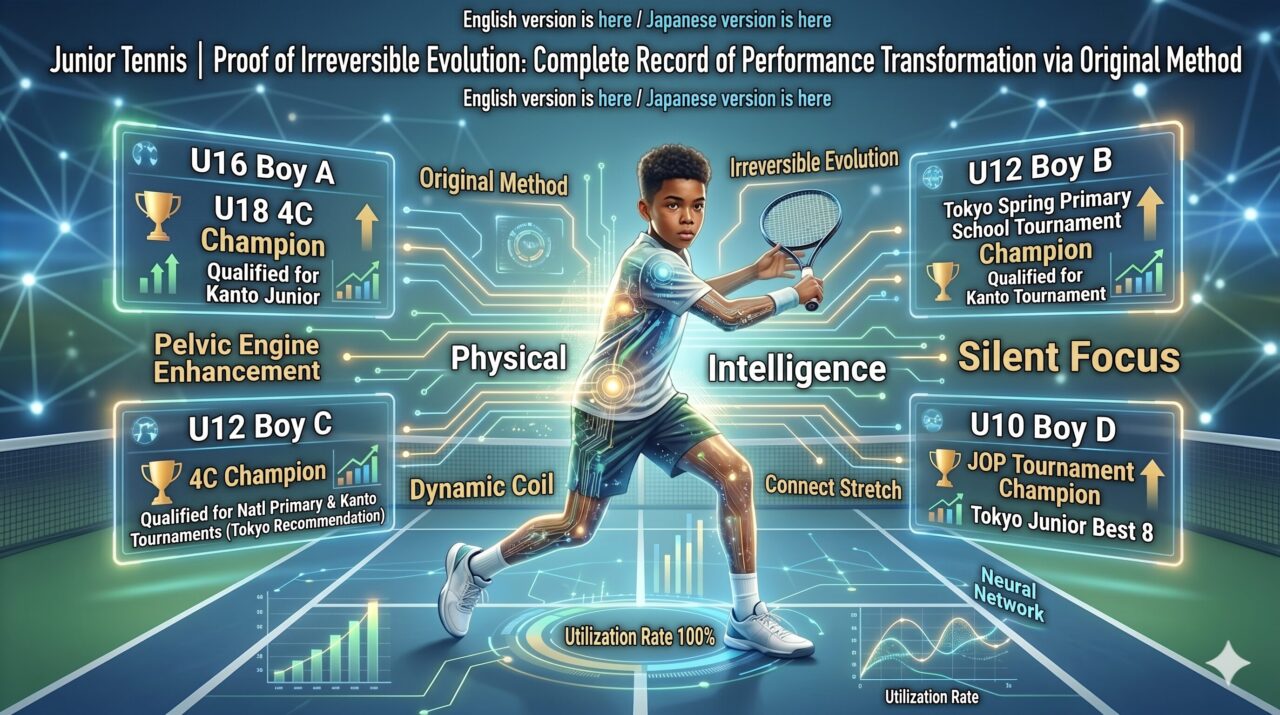
This article discloses four case studies of players who underwent direct instruction and achieved dramatic transformations in their tournament performance.
Case 01: U16 Player A (From Central Control Synchronization to Dominating Higher Categories)
Player A updated his physical structure to achieve significant results beyond his age category in less than a year from the start of instruction.
Transformation of Performance
- January 2025: Instruction started
- February 2025: Defeated in the first round of the Tokyo Jr. main draw
- December 2025: Winner of the U18 (higher category) 4C tournament
- February 2026: Advanced from Tokyo Jr. to the Kanto Jr. championships
Initiatives to Unlock Potential
- Pelvic engine reinforcement to eliminate core instability
- Dynamic Coil Movement for maximum pelvic engine output
- Accel Footwork Training to overcome sluggish initial movements
- Player Advantage Matrix to maximize the benefits of being left-handed
- Zero-Gap Training to increase grip adhesion
- Upper-In Mindful Contact Drill to maintain a wide impact zone
- Saving Eye Mobility to prevent eye oscillation during impact
- Implementation of Atypical Vector Drills
- Silent Focus Play to prevent narrowing of vision due to tension
- Practice load control tailored for upcoming tournaments
Future Update Plans
We will introduce Accordion Stretches to develop further tension and resilience. Additionally, we will upgrade tactical development focused on ball height differentials and implement optimal equipment selection based on current physical capabilities.
Addendum
The right leg over-stance (escape), which was a point of concern, has been resolved through pelvic engine reinforcement training and lead-up stretches.
Case 02: U12 Player B (Tokyo Champion and Frequent Contender in Kanto Tournaments)
Player B’s case is an excellent example of explosive evolution achieved by debugging the gap between intelligence and technique while enhancing self-detection capabilities.
Transformation of Performance
- December 2024: Instruction started
- December 2025: 4C Winner (First title)
- February 2026: Advanced to the Kanto Selection Jr. tournament (First time)
- March 2026: Secured advancement from Tokyo Jr. to Kanto Jr. (First time)
- April 2026: Advanced to the Kanto tournament via the Tokyo primary school recommendation rankings (First time)
- May 2026: Winner of the Tokyo Spring Primary School Championships
Initiatives to Unlock Potential
- Pelvic engine reinforcement to eliminate core instability
- Lead-up Stretch to overcome weak lower body elevation
- Connect Stretch to resolve upper body stiffness and inner muscle weakness
- Position Up-Down Drill to eliminate the habit of watching the ball after hitting
- Elimination of time loss during grip changes from the ready position
- Grip correction to prevent future frustration with racket work
- Silent Focus Play to alleviate shallow breathing caused by tension
- Alignment of the player’s intentions with match reality through goal setting for each tournament
Future Update Plans
We will mount Rotation Mobility to unlock the potential of the unit turn. Among the single-axis and double-axis systems, we will first install the single-axis to eliminate power loss. We also aim for further mental stability through the introduction of a self-detection protocol.
Addendum
The zero range of motion in the right coracobrachialis muscle has begun to function, albeit slightly, thanks to the Connect Stretch. He has now reached a level where a full-body hitting motion can be installed. Furthermore, we have corrected excessive split capabilities to mitigate impact on the knees, preventing damage accumulation during the junior stage.
Case 03: U12 Player C (From Engine Ignition to Reaching Kanto Tournaments)
Player C reflected his large-scale tennis style in his results by physically correcting the bug of insufficient physical structure support strength.
Transformation of Performance
- January 2025: Instruction started
- December 2025: 4C Winner (First title)
- April 2026: Advanced to the Kanto tournament via the Tokyo primary school recommendation rankings (First time)
Initiatives to Unlock Potential
- Pelvic engine reinforcement to eliminate core instability
- Engine Ignition Training to resolve gluteal support deficiency and muscle contracture
- Trajectory Variation Drills to utilize his large scale of play
- Drive Volley reinforcement to leverage tactical advantages
- Alignment of intentions with match reality through goal setting for each tournament
Future Update Plans
Priority will be given to installing the single-axis system to eliminate power loss. We will aim for consistent concentration through the introduction of single-tasking. Furthermore, we will introduce a counter protocol to resolve the scattering of attention. To compensate for training shortages caused by changes in the practice environment, we will sequentially execute play-synchronized interval training and clock mobility training to internalize his own tempo.
Addendum
Right gluteus medius dysfunction was improved through Engine Ignition Training. Since the amount of releasable energy has increased, it is now urgent to raise the consciousness level of physical operation.
Case 04: U10 Player D (First Victory via Short-term Bootcamp)
Player D, the youngest, keenly identified his physical characteristics through approximately 10 private lessons and instantly converted them into performance results.
Transformation of Performance
- January 2026: Instruction started
- February 2026: JOP Tournament Winner (First title)
- March 2026: Tokyo Jr. Quarterfinalist (First time)
Initiatives to Unlock Potential
- One-Second Focus Stop to maintain a consistent finish
- Coil and Retention to prevent arm-only hitting and encourage recognition of the body in two halves
- Up-shift Swap Drill to prevent hopping movements during transitions
- Mental Reframing of errors from the opponent’s perspective through dialogue
Architect Diagnosis and Future Plans
Results from ten 30-minute lessons and movie analysis detected insufficiency in the right trapezius and rhomboid muscles. Since covering this insufficiency is key for the future, we will stimulate these muscles and encourage reflexes through atypical vector drills using backhand hits. In the future, considering his high spatial awareness and inclination toward net play, we will refine his already potent forehand angle counter while watching his physical growth, keeping the path of a net player utilizing forehand slices as a tactical weapon in sight.
Establishment of Truth: The Future Brought by the Constructed Neural Network
Currently, there are six junior players receiving direct instruction (installation of the Master OS). Beyond the notable successes of the four players disclosed in this report (titles and Kanto advancements), all six students (100% active rate) have updated their personal bests, including breaking through qualifiers to reach main draws.
These changes in performance are the result of the Potential Tennis intelligence being correctly mounted onto the junior players (OS). By managing the player’s physical structure and central control in an integrated manner rather than providing simple technical coaching, players achieve irreversible evolution.
As the Architect’s 100-article neural network (50 Japanese, 50 English) nears completion, these cases will only increase, inevitably becoming the standard for absolute synchronization in junior tennis.



コメント