『English version is here / 日本語版はこちら』
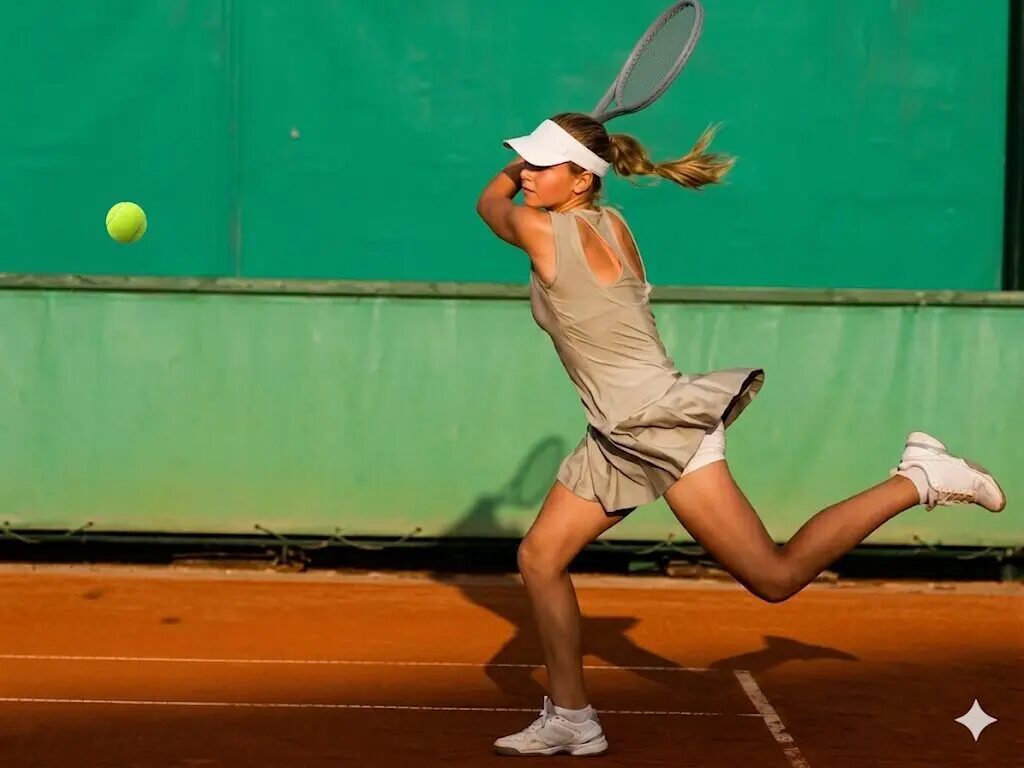
Losing balance after hitting or being unable to hit consecutively and immediately being pushed back—the very first thing junior players experiencing these issues should review is the Finish, the way the swing ends.
The Role of the Finish that Determines Junior Tennis Results
The finish is not merely the end point of the swing. It is a physical task to absorb the released power. At impact, you release accumulated power while simultaneously receiving the opponent’s power with your entire body to hit back. If that power is left released, it will not lead to linked play. In other words, it is a responsible movement to complete the shot, and at the same time, an important relay point to transition to the next movement (return to the ready position). At this time, if the blur amplitude is large, not only does the shot accuracy drop, but the body’s linkage is severed, increasing wasted momentum. To absorb the released power, you must utilize the tension of your entire body. If you suddenly release the tension after hitting the ball, the core axis collapses, delaying a smooth return to the ready position. Since the continuity of play is also lost, it is essential to control your body so as never to release its tension even after the ball has left the racket.
Correct Movement from Follow-Through to Pull-in
It is necessary to make the body thoroughly remember the basic finish. Easily repeating diverse finishes tailored to the situation carries the danger of unconsciously destroying the foundation of the form. To perform a movement means to write a new circuit in the brain and muscles. The more the stimuli from irregular finishes increase, the more the originally solid axis becomes ambiguous, ultimately lowering the perfection of the shot. The reason even tour pros repeatedly practice the basic finish is to eliminate this axis blur.
Pull-in from the Follow-Through
In the Potential Tennis method, the follow-through is defined as output management. From that follow-through (the state where the arm is extended to the maximum possible extent), the movement of sharply squeezing the racket and pulling it into the body becomes the finish. An action of simply folding the arm in a relaxed state or lifting it by inertia is nothing more than a hollowed-out runaway state. For example, in a volley, visually it looks like a movement of just pushing the ball. However, physically, just like a stroke, the pulling-in movement and the squeezing movement are meticulously woven in. Especially when the shoulder girdle is firmly supported by the muscle groups under the armpit (inner muscles), losing to the impact decreases.
Mobility for Constructing the Finish
We will introduce mobility to construct the correct finish and to grasp your own range of motion. Zero Point to Finish: First, please create a form (with the arm fully extended) that stops exactly at the follow-through. Squeezing: While maintaining the position and height, with the arm extended, please squeeze (twist) only the racket. Pull-in and Endurance: Next, please pull the arm in the direction you want to settle the finish. At this time, please strongly focus on the muscle groups under the armpit mentioned earlier and the endurance (tension) of the core. During the movement, please do not change the shoulder position as much as possible. Final Adjustment: As it is, a point will come where the racket does not settle in the desired location due to the limit of the range of motion. From there, for the first time, please fine-tune the shoulder position so that the inner endurance (tension) is not lost, and complete the final pull-in. When returning to the ready position, because you use the endurance energy created by this finish to return, you must not suddenly release your tension. It may feel like a heavy load until you get used to it, but because the loss of movement is reduced to the absolute limit, it actually becomes physically easier during intense rallies in actual combat. Please improve accuracy by incorporating techniques like the One-Second Focus Stop.
Output Management to Correctly Retain that Dominates Results More Than Moving
In junior tennis, there are often situations where correctly retaining the body determines the result more than moving it. Above all, output management at the finish can be said to be the most important task. Junior players who feel uneasy about their hitting rate or continuity of play from the middle stages of a match onward, please thoroughly embed this technique into your body. The collapse that occurs from the time you start feeling tired will change dramatically.
コメント