English version is here / 日本語版はこちら
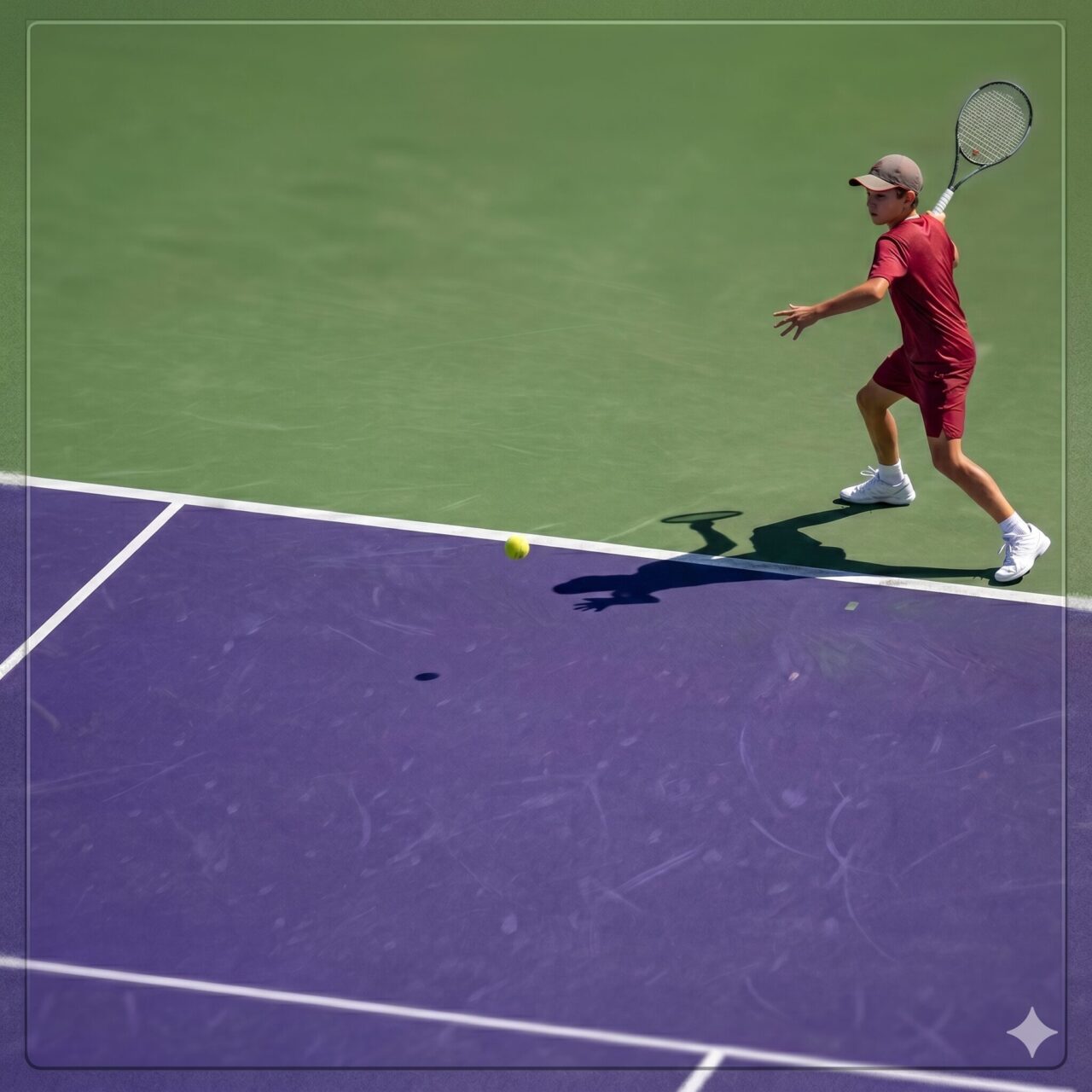
Getting into the ball is not merely catching up. From the Architect’s perspective, it refers to the calculation and execution of optimal coordinates to transfer 100% of your own output to the ball at the moment of impact. Why do errors occur more frequently on sitter balls? It is not psychological carelessness, but a calibration error regarding the physical deficit of inertial energy.
Physical Interpretation: Space Compensation to Dominate Zero Inertia
In regular rallies, you can utilize the inertia of the opponent’s shot as collision energy. However, a sitter ball (a high, slow ball) has lost this inertia and is wandering in the air. Physical Bug: Since the ball has no force, the player must generate (input) the energy themselves. At this time, if the coordinates are misaligned, the energy is not fully transmitted to the ball and turns into noise such as errors in contact point/time or frame shots. Space Compensation: For balls without inertia, it is necessary to convert your own movement energy into collision energy. For this reason, please complete coordinate adjustment through more rigorous footwork than usual.
Geometric Superiority: The Inside-out Conduction Path
The purpose of footwork to construct an accurate impact is to take a position inside the ball and ensure a conduction path in the direction of the hit. Maximizing the Moment Arm: By getting inside the ball’s trajectory, you can optimize the distance (rotation radius) from the body’s rotation axis (core) to the hitting point. Please construct an Inside-out swing that efficiently conducts centrifugal force to the ball. Securing Space: When this geometric space is insufficient, the swing is forced into a rubbing (friction) motion, and energy transfer efficiency drops significantly. Please always design a physical Space for the swing.
Implementation Log: Situational Footwork Protocols
This is a coordinate correction procedure for a right-handed player to create the optimal Space in a forehand stroke.
- Forward Calibration (Proximity) Please identify the drop point and step your right foot forward in front of your left foot. Please step in with your left foot in synchronization without killing the momentum of your right foot. Please directly link your own movement inertia to the impact force on the ball.
- Lateral Calibration (Securing Space) Please detect the cramped distance and quickly draw your right foot behind your left foot. Please expand your left foot laterally into the secured space. Please physically and forcibly secure an appropriate conduction space between the core and the ball.
System Update: Converting Positioning into Coordinate Dominance
Purge the sentiment of “running hard.” Positioning is the high-precision coordinate calculation to draw out the destructive power promised by physical laws. When this spatial calibration is complete, junior tennis moves to the generation phase of highly reproducible victory logs that are not influenced by the opponent’s ball type or tension. Please execute a reliable output from the designed coordinates.







コメント